

The AI Readiness Guide for Senior Leaders at Financial Institutions
Article
The AI Readiness Guide for Senior Leaders at Financial Institutions
The pressure to act on an AI strategy is real, and the demos are convincing. Teams successfully using production-ready AI know AI is only as good as the data underneath it. In most financial institutions, the data an AI system would need is spread across multiple separate systems: the core, the loan origination system, digital banking, the CRM, marketing platforms. Each holds a piece of the customer or member but none of them shows the full picture of the relationship. Roughly 95 percent of the value in any AI initiative comes from the data infrastructure underneath it, not from the AI model on top. A capable model pointed at scattered, inconsistent data produces confident answers your team can’t trust or verify.
Five Dimensions of AI Readiness
You don’t need a data science team to assess your readiness. You can score your institution on five dimensions. Rate each from 1 to 5. Your lowest score is your ceiling, because AI cannot perform better than the weakest part of the data it runs on.
Add your five scores. Anything below 20 out of 25 means AI will underperform until the gaps are closed. And an average of 4 can hide a 2. The single weakest dimension sets the ceiling, so fix the floor before you buy the model.
What AI-Ready Data Makes Possible
Once your data foundation is in place, use cases that felt out of reach become routine. None of the following requires a more advanced AI model. They require connected, current data, interpreted with your rules.
Grow Deposits by Targeting the Accounts That Will Actually Fund
AI-ready data lets you read balance trends, rate sensitivity, and relationship depth together to find the customers and members whose behavior signals they are ready to move money, and to reach them before a competitor does. You market to the accounts most likely to fund, which helps protect margin.
Grow Loans by Seeing Borrowing Intent You Miss Today
Your deposit data already shows you who is borrowing elsewhere. A recurring payment to an outside auto lender, a large home improvement charge, a balance building toward a down payment: each is a lending opportunity sitting inside your own core, invisible until the data is connected.
With an AI-ready foundation, your bankers can see these signals and act on them. A member making payments to an external auto lender becomes a refinance conversation. A customer with strong home equity and rising renovation spending becomes a HELOC candidate. On the commercial side, connected data surfaces the full relationship, so you can spot the operating business that keeps its deposits with you but finances its equipment somewhere else. You lend into demand you already have, rather than chasing rate shoppers you do not know.
Deepen Relationships by Acting Before Customers and Members Leave
Attrition rarely happens without warning. Direct deposit stops, balances drift down, digital logins may slow down. AI-ready data can flag those patterns early, so your team can reach the right person with the right message while the relationship is still there to save. Institutions that act on these signals can reduce preventable customer and member loss.
The same foundation drives growth on the other side of the relationship. By reading financial behavior, life events, and product utilization together, AI can surface the next right product for every customer and member automatically, not only the ones a banker happens to remember to call. Done well, this can improve cross-sell conversion by three to five times, because the offer is relevant and the timing is right.
The Questions to Ask Before You Buy
These questions are designed to assess whether a tool can create value on your data.
- Will you audit our data before you sell us anything? If the answer is no, the pilot is likely to stall on cleanup you did not budget for.
- Does the tool run on our raw data, or on a governed, AI-ready foundation built with our rules? Raw data in means unverifiable answers out.
- Can it show its work? When it makes a recommendation, can we trace the inputs and explain the decision to an examiner?
- How are we charged? Per query, or for prepared results? What does that cost at the scale of our full base, run every day?
- Was this built for community banks and credit unions, or adapted from a generic enterprise platform?
Your 60-Day Path to AI Readiness
Weeks 1 – 2: Run a data audit
Bring together IT, operations, lending, and marketing. Map every system that holds customer and member data. Score the institution against the five dimensions above.
Weeks 3 – 4: Prioritize one use case
Pick the use case with the clearest business case, whether that is deposit retention, cross-sell, or lending. Define what success looks like before you evaluate a single vendor.
Weeks 5 – 8: Brief your board
Your AI strategy is your data strategy. Give the board a briefing on the gaps and the investment required, framed as risk mitigation and competitive positioning rather than a technology project. This pairs naturally with the security readiness conversation your board is likely already having.
Ready to Assess your AI Readiness?
Data readiness is what lets AI grow deposits, grow loans, and strengthen the relationships that have always been a community institution’s advantage.
At Aunalytics, we build that foundation. We do not just connect your data. We transform it into a clean, structured, AI-ready foundation built with your rules and your priorities, so an AI agent like Auna can tell your bankers who to target, when to act, and what to say. The model gets the attention. The data does the work.
Talk with an Aunalytics expert about where your data foundation stands today and what it takes to get AI working for your institution. Contact us today: aunalytics.com/contact


Your Bankers Know What to Do. They Just Can't Get to Every Account.
Article
Your Bankers Know What to Do. They Just Can't Get to Every Account.
Ask a room of bankers what their institution is missing, and you’ll rarely hear “we don’t know what to do.” A seasoned relationship manager can look at an account and tell you the loan is about to reprice, the deposit balance has slid for two quarters, and the owner is the type to move the whole relationship if a competitor calls first. The knowledge is there. What’s missing is the time to act on it across every account, not only the handful that happened to surface this week.
In most financial institutions, and the IT teams that keep them running, the right answer already exists inside the proverbial building. The hard part is relationship manager capacity: getting that answer to everyone who needs it, at the moment they need it.
Where Relationship Manager Capacity Is Limited
That gap is capacity. In the AI strategy and implementation conversations happening inside financial institutions, there’s a useful question too few are asking: Where is your organization really constrained? For a financial institution, or the IT team keeping it online, the answer is almost never a shortage of good judgment. It’s a shortage of the people who hold that judgment, multiplied by the number of hours in their week.
Once you see the constraint as capacity, the shape of the solution changes. Capacity is made of two things, and they are often confused. The first is coverage: showing up at all. The second is judgment: knowing what to do once you are there. A relationship manager with sharp instincts and forty accounts covers those forty well and leaves three hundred more to chance. A brand-new banker may have the time but not yet the instinct to know which signal matters. Most of the tools sold to close this gap deliver one quality without the other. A dashboard hands you coverage with no judgment. You work out what it means. A consultant hands you judgment with no coverage. Excellent advice, shared one time with a few teams.
An AI agent carries both at the same time. The judgment an agent applies inside your institution is not invented by a model. It’s captured from your institution: how your best people read a situation, and which signals really predict a customer or member walking out the door. That captured judgment is then delivered at the scale of coverage, showing up in every account and every ticket rather than only the ones a person had time to reach.
What This Looks Like With Auna
Here is what that looks like in practice. Auna is our AI agent for financial institutions, powered by our Intelligent Data Warehouse. A banker’s book is always bigger than their week, so coverage collapses to whatever felt urgent. Auna covers the whole book instead of the fraction that surfaced, and brings the relevant insight forward at the moment it matters, so a banker can act with confidence rather than dig for context first. The effect on a team is easy to underrate. A newer banker walks into a conversation already knowing what the most experienced person in the building would notice, and why. Judgment that used to live in a few heads starts showing up in everyone’s.
Coverage and judgment have to move together. On its own, coverage is only noise: more alerts and more confident wrong answers, reaching more people faster. And judgment is no better than what you capture it from. An agent drawing on messy data will carry bad instincts into every interaction. This is why the foundational work of making data AI-ready comes first, and why, in a regulated institution, examiner-ready governance is what makes that judgment trustworthy in the first place. A confident answer that no one can explain is still a guess.
Serve the Whole Book, Not the Best Few
The people who understand your customers and members are where the judgment came from. Giving that judgment more reach doesn’t replace them. It takes the understanding your institution has already earned, sometimes over decades, and lets it show up in every account and every conversation your best person can’t personally be in. Give your team both, and your bankers can serve the whole book with the confidence they used to save for their best few relationships.
Use AI to Determine, Not Just Infer: Why Declarative AI Matters
Article
Use AI to Determine, Not Just Infer: Why Declarative AI Matters for Regulated Institutions
AI companies are racing to convince you that their models are smart enough to figure out your business. However, most enterprise AI deployments quietly fail in the gap between that promise and what regulated institutions actually need — a gap that declarative AI is built to close.
You’ve probably sat through a compelling AI demo. Their model answers fluently, summarizes documents, and generates reports that look like what your team spends hours producing by hand.
But then someone in the room asks whether it knows how you define a primary banking relationship. They ask whether it applies your credit policy thresholds the same way every time, and what you’d show a regulator who questioned a decision it made. Those are the questions that separate AI that looks good from AI that works for your institution, in your regulatory environment, at the stakes you’re operating under.
The Flaw in Model-Centric AI
A growing number of AI vendors are building what are called model-centric systems, on the premise that a sufficiently capable model given enough of your data will figure out your business. The models are genuinely impressive, but model intelligence isn’t what solves the problem these institutions face.
Every regulated institution — community bank, credit union, company running enterprise IT under compliance requirements — operates on institutional knowledge that is declared rather than discovered. Your definition of a criticized asset, your risk rating thresholds, and your rules for what triggers a relationship review aren’t patterns hidden in your data waiting for a model to find them. They are decisions your institution has made, codified in policy, and required to be applied consistently across every loan review, compliance filing, and customer interaction.
When a model-centric AI system tries to apply your institutional logic, it doesn’t read your policy manual and execute it. It infers what your logic probably is, based on patterns in your data and whatever context you’ve fed it at the moment of the query. Every answer is a probabilistic approximation of a declarative truth.
That level of approximation is acceptable for marketing copy, but not for a credit decision, a regulatory disclosure, or a risk report going to your board.
Declarative AI vs. Inferential: The Distinction That Changes Everything
There are two fundamentally different ways to make an AI system work:
Inferential AI asks the model to reason its way to the right answer using whatever data and context you provide, making the model itself the intelligence layer. In theory, a better model produces better output. In practice, the model’s output varies based on how a question is phrased, what context was retrieved, and what version of the model is running, so there is no single authoritative answer, only the current best inference.
Declarative AI encodes your institutional logic into the data foundation before the model ever sees it, expressing your definitions, rules, and thresholds as an explicit, governed data architecture. The model doesn’t need to infer what “aggregate calendar-year deposits” means, because your intelligence layer has already defined and computed it. The job of the model is to reason over a foundation of established fact rather than construct that foundation on the fly.
For companies in regulated industries, it’s the difference between an AI system you can stand behind and one you can only hope doesn’t embarrass you in front of an examiner.
Why "Better Models" Aren’t the Solution
The standard vendor response is that models are getting better fast, and soon they’ll handle institutional complexity reliably. Models are improving rapidly, but improvement doesn’t resolve the declarative vs. inferential problem. A more capable model makes better guesses; it doesn’t turn guesses into facts. Your credit policy isn’t a pattern to be discovered at higher confidence levels. It’s a decision to be applied with complete consistency.
Governance is the dimension that will eventually land on a CEO or CIO’s desk personally. SR 11-7 and similar guidance require your AI systems to be explainable and auditable, which means when an examiner asks why a decision was made, “the model reasoned its way to this answer” isn’t a defense — it’s an admission. A governed rule with documented provenance is something you can put in front of a regulator, a board risk committee, or your own general counsel. Model weights are not.
There’s also a cost structure dimension that matters more the longer you run the system. Model-centric AI is a variable cost that scales with usage: every query, every user, every new workflow adds to the bill, and the more your institution embraces AI, the faster the number grows. Platform-centric AI is closer to a fixed cost you build once, where the marginal cost of additional use is near zero. Per-token prices will keep falling, but they won’t close this gap, because the volume of tokens required to re-derive your institutional context at query time doesn’t compress. By year three, the two architectures produce very different numbers on your P&L.
The Integration Problem Nobody Talks About
There’s a harder truth underneath all of this that the AI demos never address: most enterprise AI deployments fail not because the model isn’t good enough, but because the data isn’t ready.
Your customer records live in one system, transaction history lives in another, and loan origination data lives in a third. None of those systems were designed to talk to each other, and none of them have consistent definitions of shared concepts. “Customer” means something different in your core banking platform, your CRM, and your treasury management system.
Getting an AI model to reason accurately over that environment isn’t a prompt engineering challenge; it’s a data engineering one. It is the part most AI programs systematically underestimate. Resolving customer identity across a core banking platform, a CRM, and a treasury system, reconciling how Fiserv or Jack Henry structures accounts against your own definitions, and maintaining those definitions through core upgrades and acquisitions requires years of domain-specific work. When an AI initiative stalls or comes in over budget, this is almost always where it happened.
This is the work most AI vendors skip. They show you what the model can do once someone else has solved the data problem. They leave the data problem to you.
The data foundation is the moat — not because it’s expensive to build, but because it takes years to do right and it’s specific to your institution. When a competitor promises to replicate it with a smarter model, they’re proposing to shortcut a decade of domain-specific engineering. That’s not a technical claim. It’s a sales claim.
Three Things to Require Before You Commit Budget
If you’re a CEO or CIO evaluating AI investments, there are three things worth requiring of any vendor before you commit budget.
Require that your institutional logic lives in the data layer, not in the model or the prompt. Your definitions and business rules should be explicit, governed, and independent of the model, so they survive vendor changes, model upgrades, and staff turnover. If a vendor can’t show you where that logic lives, you’re being asked to store your institution’s intelligence inside someone else’s product.
Require a clear model-upgrade path that doesn’t put your institutional knowledge at risk. In a model-centric architecture, a model upgrade can invalidate the logic encoded in the current model, forcing you to revalidate your AI every time the vendor ships a release. In a platform-centric one, the intelligence layer is model-independent and the model is a swappable component. Ask your vendor to explain their upgrade path.
Require that every AI-supported decision be defensible to a regulator on its own terms. You should be able to point to the rule itself — when it was authored, what data it depends on, what it produces — not a description of what the AI probably did. If a vendor can’t produce that, you’re the one who will be asked to explain it.
Before deploying any AI agent or generative capability into a regulated workflow, verify that the underlying data is trustworthy, governed, and AI-ready, with resolved customer identity, codified business definitions, and derived intelligence maintained as standing metrics rather than computed on demand. Build incrementally, but anchor the roadmap on what architecture serves your institution in year three, not what you can show in thirty days. And insist on model independence, so that as foundation models improve, you benefit from the improvement without having to revalidate your institutional logic.
The AI companies competing for your budget are offering real capability, and the models are improving, but model capability is increasingly a commodity. What isn’t a commodity is a declarative AI foundation — governed, institution-specific, and built to give every model you deploy established fact to reason from. That foundation is what separates AI that works in a boardroom presentation from AI that works at 8 AM on a Monday, when your banker needs to know who to call, why it matters, and what to say — and needs to be sure it’s right.
AI is Only As Good As Your Data
Article
AI is Only As Good As Your Data
Every week, another AI vendor promises their platform will transform your financial institution. Better member insights, smarter lending decisions, and automated reporting. The pitch is compelling and the pressure to act is real.
Before you sign a contract, there’s a question worth asking: Do you actually have the data to back it up?
AI is only as good as the data underneath it. And most financial institutions don’t have the data that’s ready for AI yet.
The key is starting with your data foundation first.
For financial institutions, the challenge isn’t the amount of data, it’s the data readiness. When you skip the step of cleaning and structuring your data and go straight to the AI layer, here’s what happens:
- The AI produces answers that feel authoritative but are statistically probable, rather than being declaratively accurate.
- You can’t audit the decision: you don’t know why it said what it said.
- You keep running the same calculations over and over, driving up costs with every query.
This isn’t a tech failure. It’s a sequencing failure. The intelligence has to be built into the data before you hand it to an AI.
What "AI-Ready Data" Actually Means
AI-ready data has been transformed, enriched with business logic, and structured so that when a question is asked, the answer is calculated, not guessed.
Think of it this way: if you ask an AI to tell you which members are at risk of leaving this quarter, it needs more than raw transaction records. It needs a unified view of each member’s relationship with your institution, behavioral signals over time, and the business rules your team uses to define “at risk” in the first place. That context must be built in.
The intelligence is in the platform. You must build it into the data layer before AI can deliver answers you can trust and act on.
Two Approaches and Why They're Not Equal
Approach One: Ask the AI to Figure It Out
Some vendors take raw data, often pulled from a cloud warehouse, and let the AI model do the calculations on the fly. The model ingests your data, runs its analysis, and returns an answer.
This sounds efficient. It’s not. Every calculation runs repeatedly, consuming tokens and compute resources with each query. Costs scale with usage, not with value. And when you ask, “why did you flag this member?” the answer is a statistical distribution, not a reason.
Approach Two: Pre-Compute the Intelligence
The more effective approach, and the one Aunalytics is grounded in, is to do the hard work before the AI ever sees the question. Every relevant metric, every business rule, every behavioral signal is calculated, validated, and stored in a structured intelligence layer.
When a question comes in, the AI retrieves a precise answer from data that was already prepared for it. The result is faster, cheaper, more accurate, and fully auditable.
This is what we mean when we say Aunalytics makes data AI-ready.
What This Means for Your Institution
If you’re a CEO, CIO, or CTO at a financial institution, this distinction matters for three reasons:
- Accuracy: Declarative answers built on prepared data are more reliable than probabilistic outputs from raw data. When a banker acts on an insight, they need to trust it.
- Auditability: Regulators and examiners want to know why a decision was made. With pre-computed intelligence, you can show your work. With probabilistic AI, you can’t.
- Cost: Paying for compute on every query — at scale — adds up fast. Pre-computed data means you’re paying for results, not repeated calculations.
The Partner Question
Most community financial institutions don’t have the data science teams, the infrastructure, or the time to build this foundation themselves. They don’t need to.
But they do need a partner who’s already done the work — one who understands community banking deeply and can deliver production-ready AI data as a service.
That’s not a software tool. It’s not a dashboard. It’s a managed service built on years of experience working with the specific data structures, core systems, and regulatory environment of community banks and credit unions.
Aunalytics has been building and refining banking-specific data sets for over eight years. The Intelligent Data Warehouse isn’t a general-purpose platform adapted for banking. It was built for banking from the ground up.
Before you evaluate the next AI platform, ask the vendor one question:
What does your solution do to prepare my data for AI before the AI ever touches it?
The answer will tell you everything.
Start With the Right Foundation
The institutions that will win with AI aren’t the ones who adopt it fastest. They’re the ones who build the right foundation first — and find a partner who can help them get there without building a data science department from scratch.
The Efficiency Ratio Problem No One Is Actually Solving
Article
The Efficiency Ratio Problem No One Is Actually Solving
Every year, we attend banking conferences and hear advice echoed from stage after stage: “Get your data together to use AI.” It’s become a mantra in the industry. Everyone agrees it’s important, and then most go home and nothing meaningfully changes.
Data matters. And the leaders I talk to know it matters. The part that many miss today is understanding what “getting your data together” really means. That gap, between the slogan and the substance, is good news. It means the biggest opportunity to improve your efficiency ratio is still in front of you.
The Advice Everyone Gives but Nobody Finishes
When most people talk about getting your data together, they mean integration. Pull it from your core, your loan origination system, your CRM, your general ledger, and get it into one place, maybe a dashboard. Consolidated reporting is better than fragmented reporting, but if the end goal is using artificial intelligence to drive your efficiency ratio, then integration is step two of a ten-step journey.
The good news? The next steps are clearer than you might think.
What “getting your data together” really means is something far more granular and far more valuable. It means refining your data. It means embedding business context, encoding the business logic of your specific bank. It means having your data ready to use AI. Once you understand that distinction, the path forward becomes surprisingly actionable.
What Is a Data Foundation, Really?
A properly built data foundation is the unlock to using AI. It’s the key to doing the work you already do, but quicker, easier, and smarter.
Context matters because an LLM is extraordinary at processing language, identifying patterns, and generating output. What it cannot do, on its own, is understand that when your bank says, “Primary Relationship” or “Class 3 commercial real estate,” it means something slightly different than when the institution next door says the same thing. It doesn’t know your policy exceptions, committee preferences, or the dozen small decisions your best banker makes without even thinking about them.
That’s business logic. And every bank’s logic is different, which is a strength. Your institutional knowledge is a competitive asset. The data foundation doesn’t just store your data. It teaches AI how your bank actually works, preserving and scaling the expertise your team has built over years.
The Credit Memo Example
Take credit memo writing. It’s the example that illustrates the opportunity clearly, and once you see it, the same pattern shows up across the institution.
A credit memo is a structured synthesis of financial data, borrower history, market context, policy compliance, and risk assessment. It’s organized in a way that tells a clear story to a credit committee. It requires knowledge, context, and consistency.
A commercial banker and credit analyst might spend hours on a single credit memo. Not because the intellectual work is that complex, but because the assembly is. Pulling data from multiple systems, cross-referencing financials, ensuring the narrative aligns with current policy, formatting it correctly, reviewing it for completeness. Your bankers shouldn’t be spending their best hours on assembly.
Now the exciting question: what is stopping AI from writing that credit memo?
Frontier LLMs can synthesize, analyze, and write at extraordinary levels. What’s stopping them is context and business logic. The AI doesn’t know your bank’s specific credit policy. It doesn’t know how your committee likes to see deals presented. It doesn’t know that your chief credit officer always wants to see the debt service coverage calculated a certain way, or that your institution has a specific appetite for owner-occupied CRE that differs from the industry norm.
But if you’ve built the data foundation, if you’ve done the important work of refining your data, embedding your context, and encoding your logic, then an AI agent can draft that memo in your format, with your logic. The commercial banker reviews it, applies judgment, and moves on to the next relationship. The work that took hours now takes minutes. Multiply that across your team, across your branches, across a year, and you’re looking at a meaningful shift in your efficiency ratio from a single AI capability: writing credit memos.
A Framework for Doing This
So what does this look like in practice? I’d suggest a framework that starts with the work, rather than the tech.
Decompose. Pick a role: commercial banker, credit analyst, branch manager, compliance officer. Map the activities that role performs. Be specific. Instead of “lending,” think “spreading financials from tax returns.” Instead of “compliance,” think “reviewing BSA alerts and documenting decisions.” You’ll be surprised how clarifying this exercise is.
Categorize. Which of those activities require judgment, relationships, or creativity? Which are information processing: data retrieval, synthesis, pattern matching, structured output? When you free your people from assembly work, they can focus on the high-value activities that drew them to banking in the first place.
Build the foundation. This is the work that matters most and gets talked about least. Refine your data. Contextualize it. Encode your business logic. Build the data infrastructure that turns your raw institutional knowledge into something an AI can reason with. This is a strategic investment, and it’s the step that separates institutions using AI from institutions talking about AI.
Deploy with precision. Start with one AI agent — conversational, accessible, embedded in your workflow — that takes on one specific, high-leverage activity. Credit memo drafting. Loan covenant monitoring. Exception tracking. Whatever generates the most time savings for the most people. Prove the value, build trust, then expand.
The Efficiency Ratio Is a Lagging Indicator of a Leading Decision
Every CEO I talk to cares about their efficiency ratio. It’s one of the clearest measures of how well an institution converts revenue into profit. But here’s what I’d encourage every leader reading this to consider: the efficiency ratio of the future won’t be driven by the same levers as the efficiency ratio of the past.
It will be driven by how effectively your people are equipped to do their work. It will be driven by whether your institution has built the data infrastructure to let AI do what AI is uniquely qualified to do, so your people can do what they’re uniquely qualified to do. The institutions that invest in foundational, context-rich data work now will operate at a level of efficiency that sets them apart.
That’s the future driver of efficiency ratio. It’s not a dashboard. It’s not a chatbot bolted onto your website. It’s a data foundation that knows your bank as well as your best banker does, and an AI layer that puts that knowledge to work, every day, at scale.
The opportunity is here. The path is clear. And the institutions that move now will be the ones that define what community banking looks like for the next generation.



Staying Secure: Recent Security Breaches and Essential Prevention Strategies
The increasing reliance on digital technologies has led to the increased frequency of security breaches. Recent incidents have highlighted vulnerabilities across several industries, emphasizing the importance of robust cybersecurity measures. Here, we examine some notable security breaches that have recently made headlines, detailing the “how” and the responses taken to mitigate future risks.
Microsoft Azure and Executive Accounts
In a significant cyberattack on Microsoft Azure in January 2024, hackers exposed the accounts of hundreds of Microsoft senior executives to unauthorized access, with the use of phishing attacks and malicious links. The attackers used a password spray attack to break into the accounts, which is when an attacker tries several passwords across multiple user accounts to avoid detection systems. This breach allowed unauthorized access to Microsoft email accounts, leading to the exfiltration of sensitive emails and attached documents. The attackers also targeted source code and infrastructure, emphasizing the importance of heightened vigilance against sophisticated phishing tactics.
One extremely effective way to ward against this type of attack is to create strong passwords and change them regularly to prevent them from being hacked, as well as using multi-factor authentication.
Bank of America Third-Party Data Breach
Attackers understand that large banks have robust cybersecurity measures to protect their networks. However, many third parties lack similar resources and may not yet prioritize cybersecurity education or infrastructure. This makes them more likely to be targets for cybercriminals seeking vulnerabilities to exploit when sharing data with major institutions. This incident underscores the critical need for financial institutions to strengthen third-party vendor security protocols and ensure robust data protection measures.
The ransomware group LockBit orchestrated a breach targeting Bank of America in February 2024 via its third-party vendor, Infosys McCamish. Personal information—including names, Social Security numbers, and account details of over 57,000 individuals—was compromised.
Ascension Ransomware Attack
Such attacks necessitate comprehensive cybersecurity strategies to safeguard critical healthcare infrastructure and ensure uninterrupted patient care. Moreover, ensuring robust disaster recovery plans and reliable backups can get services back on track faster, which is particularly crucial for healthcare systems, because extended delay can directly impact patient care and safety.
Ascension, the owner of 15 hospitals in Michigan, fell victim to a ransomware attack in May 2024 that disrupted electronic health records systems, phone systems, and scheduling processes. Non-emergency procedures and appointments were suspended, highlighting the operational impact of cybersecurity incidents on healthcare services.
New York City Metropolitan Transportation Authority (MTA) Cyberattack
In 2020, research showed that municipalities, which are already vulnerable targets for cybercrime, faced 44% of global ransomware attacks—equating to approximately 133,496,000 incidents. An April 2021 cyberattack on the New York City Metropolitan Transportation Authority (MTA) compromised 18 systems, including those controlling train operations and safety mechanisms. This breach posed serious implications for public safety and operational continuity.
Following the attack, MTA swiftly implemented federally recommended security enhancements and mandated password changes and VPN switches for employees and contractors, illustrating proactive steps to fortify cybersecurity defenses.
Moving Forward: Prevention Procedures
Preventing security breaches requires a multi-faceted approach that empowers teams and safeguards organizational assets. Regular training sessions are essential to educate employees on identifying phishing emails, creating robust passwords, and understanding the importance of safeguarding sensitive information. This measure ensures everyone understands their role in preventing data breaches.
Strengthening asset management through classification, organization, automation, and continuous monitoring helps maintain an up-to-date inventory, facilitating informed decision-making and enhancing troubleshooting capabilities. Effective management and monitoring of access rights, supported by IAM, routine account audits, SSO, and multi-factor authentication, are also critical for ensuring only authorized personnel have access to certain resources.

Another strategy to prevent security breaches is implementing robust firewalls and antivirus software services, which can serve as the frontline defense against malicious threats. Regular updates to these defenses are crucial to identifying and addressing vulnerabilities promptly. Additionally, implementing automated data backup systems across multiple locations provides a safety net against data loss and physical damage, ensuring business continuity even in the face of unforeseen incidents. By integrating these preventive measures into comprehensive cybersecurity strategies, organizations can effectively mitigate risks and protect sensitive information from increasingly sophisticated cyber threats.
At Aunalytics, we are committed to preventing security breaches—protecting customer data is our top priority. We adhere to stringent security protocols, including regular employee training, robust encryption measures, and continuous monitoring of access controls. Our goal is to ensure our clients are utilizing the latest security technologies and best practices to stay protected, while having the right backup and disaster recovery strategies in place to get their businesses back up and running as quickly as possible in the event of a cyber event or disaster scenario.


Banking Forward: Analytics Trends in Financial Services

Banking Forward:
Analytics Trends in Financial Services
In the world of financial services, staying ahead of competition means embracing analytics trends that enhance customer and member experiences and operational efficiency. As technology continues to reshape the industry, financial institutions are turning to advanced analytics solutions to gain insights on customer and member behaviors.
Higher Customer and Member Engagement through Online and Mobile Services
Improving the online and mobile experiences is at the forefront of modern banking strategies. Institutions are not only investing in robust mobile banking apps but also leveraging app data to gain deep insights into customer or member behavior. By analyzing transaction patterns, engagement metrics, and user feedback, banks can uncover valuable insights that inform strategic decisions and improve service offerings. This increased access to mobile services significantly enhances the customer and member experience by providing convenient access to financial information anytime, anywhere.

It’s important to note that improved mobile services play a crucial role in shaping personalized experiences, which have become a cornerstone of customer engagement in the banking industry. Through advanced analytics, banks can decipher intricate client data to understand their preferences, goals, and financial behaviors. This allows them to create tailored advice and personalized financial plans on a large scale. Detailed client profiles allow banks to anticipate needs and offer relevant products and services proactively, thereby enhancing customer satisfaction and loyalty.
Highly Personalized Advising
Advising Services, like personalized experiences, is another solution that ensures each client receives tailored assistance aligned with their specific needs. Advising Services have evolved significantly with the integration of customer relationship management (CRM) technology. By using CRM tools, banks can compile comprehensive customer profiles enriched with transaction history, communication preferences, and financial goals. This wealth of data allows financial advisors to deliver customized guidance that addresses each customer’s unique circumstances and aspirations. Such personalized advisory services foster stronger client relationships, driving loyalty and retention in a competitive market.
Enhanced Customer Service through AI-Powered Chatbots
Similarly, AI (Artificial Intelligence) is revolutionizing customer interactions within the banking sector and how they might seek out help. AI-powered chatbots are being deployed to handle routine inquiries and provide instant assistance, reducing wait times and enhancing customer satisfaction. These chatbots are integrated seamlessly into banking platforms, offering users real-time support and guidance. Moreover, AI-driven virtual assistants are being used to deliver personalized money management tips, empowering customers and members with actionable insights to make informed financial decisions.
Open Banking Initiatives
And while AI is implemented to assist clients, open banking ensures that clients retain ultimate control over their data. Open Banking represents a new era of connectivity and collaboration in financial services. By securely sharing customer information through APIs (Application Programming Interfaces), banks can build partnerships with third-party applications and services. This integration allows for enhanced functionalities such as aggregated financial insights, streamlined payment processes, and personalized financial recommendations.
Predicting and Preventing Fraud and Cyberthreats
Finally, with the increase of cyberthreats and ransomware, cybersecurity and fraud detection continue to trend as well. Effectively identifying and mitigating malicious threats calls for strategic planning and investments in tools and infrastructure. Investing in cybersecurity further enhances customer and stakeholder trust by committing to protecting their data and assets.

In conclusion, the banking and credit union sectors are embracing advanced analytics trends to enhance customer experiences, streamline operations, and drive sustainable growth. By leveraging technologies like AI, CRM, and open banking principles, institutions can deliver personalized services that cater to individual needs and preferences effectively. Embracing these trends not only positions banks as industry leaders but also ensures they remain relevant and responsive to evolving customer expectations in a digitally-driven world.
At Aunalytics, we are committed to empowering community banks and credit unions with cutting-edge solutions that leverage these trends. By partnering with us, community banks and credit unions can optimize their operations, strengthen customer and member relationships, and prevent cyberattacks and fraud events that can erode consumer trust. We believe in supporting our clients to ensure that they remain at the forefront of the financial services sector.

Becoming More Customer-Centric—How Community Banks and Credit Unions Can Cultivate This Mindset and Act on It
Personal, white glove service has always been a competitive advantage for community banks and credit unions. Therefore, a customer-centric mindset is vital. While a customer may be just another number at a large, national bank, community-based financial organizations can get to know people on a more personal level—and they may in turn feel a larger sense of connection and loyalty to a bank or credit union that has a history within the community.
But, as banking moves to be more digitally-focused, a familiar, friendly face at the bank counter is not enough, especially as younger generations embrace the convenience of online and mobile banking. Customer touch points are increasingly digital—which isn’t necessarily a bad thing. Financial institutions now have a wealth of data about each individual. Large, national banks are already using this to their advantage.
Many large financial institutions have invested billions in technology, including data and AI-based solutions that allow them to fully embrace customer centricity in their business practice. This allows them to foster relationships based heavily on digital interactions.
But without ample resources that can be focused on developing data-backed solutions, how can a smaller, community-based institution compete?
Adopting a Customer-First Mindset
While a focus on the customer or member is the bread and butter of most community banks and credit unions, there is always room for improvement. While customer centricity is a sought after ideal, only about 9% of organizations have achieved this goal. This can make it a competitive differentiator for organizations who manage to fully embrace this mindset. To become a truly customer-centric organization, it’s not enough to provide a high level of customer service. It requires customer centricity to be embedded in the organization’s DNA and across all functional areas of the financial institution.
A customer’s interaction with an organization goes beyond the tellers at the branch, or a mobile app’s user interface (though these are each vitally important elements!) There are some questions to consider when evaluating whether an organization is truly putting the customer first:

- Are your products and services what your customers really want and need?
- Are recommendations and advice being tailored to each unique individual?
- Are customers experiencing seamless interactions across all touchpoints?
- Are you using direct feedback and data to inform decision-making?
- Are you able to provide customers with “unexpected value,” beyond what they would normally expect from their financial institution?
In order to reach these lofty goals, organizations must first get buy-in across the organization and actively work to shift goals and mindsets.
Embracing The Power of Data and AI
Once a bank or credit union has determined that it is on its way to cultivating a customer-centric mindset, it is time to start taking action. One of the most powerful ways to become more customer-centric is to rely on insights from data. But the first step is to organize data into a 360-degree view of each customer—breaking down data silos in order to capture the entire customer journey.
Once data has been aggregated, cleansed, and organized around each customer, it can be used to make data-driven decisions, personalize the customer journey, and increase the effectiveness of marketing campaigns, and optimize operations. With the power of AI and predictive analytics, organizations can:
- Enhance digital interactions with chatbots;
- Enact offer relevant product suggestions;
- Determine which customers or members are most likely to churn;
- Identify potential new customers who look the most like their current best customers;
- Optimize loyalty programs to increase customer satisfaction; and more.
Where To Start?
If all of this sounds like a lofty goal, that is because it is. This undertaking can be a huge challenge for most midsized banks and credit unions. In many cases, it could take several months—or even years—to get to this point. That is why many organizations are looking outside their own walls to work with experienced partners to guide them through the process along with pre-built technology solutions that can reduce the time to implementation.
To meet the unique challenges of community banks and credit unions, Aunalytics has developed the Intelligent Data Warehouse—an end-to-end data and analytics platform using AI and machine learning to enrich a bank or credit union’s existing data and create a customer-centric view. This ultimately allows midsized financial institutions to more effectively identify and deliver new services and solutions so they can increase wallet share and better compete with large financial institutions.

Financial Institution Cyber Attacks Are on the Rise—Your Institution Is Not Immune
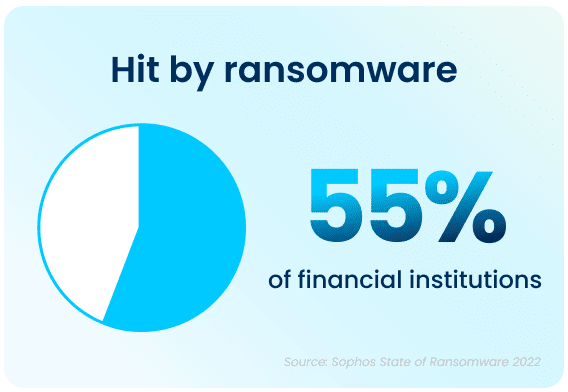
With recent uncertainty in the economy and bank closures hitting the news this year, you may be scrambling to find ways to increase deposits to protect your institution. But a larger, more urgent risk has always been lurking. With over half of financial institutions reporting cyber attacks in a single year, your organization may be next.
Nearly every day we learn of new horror stories from financial institutions who were the victims of elaborate attacks—in fact, 55% reported being a victim of a cyber-attack in a single year.
Bad actors are becoming more sophisticated in their methods. These prevalent attacks have high costs to your business uptime and productivity. A bad attack can also damage your reputation due to closure and data loss, while still costing your bank or credit union large sums of money to pay off ransoms—and you may not even get all of your data back.
Financial institutions hit by cyber-attacks pay, on average, $272,655 in ransom payments. And the average overall cost to remediate the ransomware attack in this sector is $1.59 million.
Do you know where your data lives?
Where you store your data matters, and your storage location may not be optimal for disaster recovery. Storing your backups locally, even if located at another of your facilities, may not protect your data from unknown risks.
In-house servers require large capital expenditures, and you miss out on economies of scale for regular upkeep and maintenance. Giant vendors may seem convenient, but you won’t know exactly where your data resides, and you lose control over the environment.
There’s a better way—Aunalytics backup and disaster recovery solutions can help you avoid losing data or paying large ransoms. We offer concierge solutions tailored to community banks and credit unions—helping you stay steps ahead of increasingly malicious attackers.

Backup and disaster recovery solutions enable the continuous operations of an organization during a disaster event, whether it involves a set of networks or servers, or when all primary IT services have become unavailable. Our solutions leverage the power of data, analytics, and Machine Learning. Disaster Recovery Services, coupled with a comprehensive backup and archival strategy, allow you to remain confident that you are prepared should your business encounter a disaster event.

Investment in Artificial Intelligence is Vital for Banks and Credit Unions
Has your bank or credit union made investments in artificial intelligence yet?
Advances in artificial intelligence (AI), and the promise it holds for the future, have been making news all year. And it’s no wonder that financial institutions are taking notice—a recent survey from the Economist Intelligence Unit found that 77% of bankers believe that unlocking value from AI will be the differentiator between winning and losing banks. Yet, many institutions are falling behind in AI maturity.
Despite its promise, making a large investment in artificial intelligence may seem risky to many midsized financial institutions. Hiring talent, developing a data management and analytics strategy, building a data platform, and creating AI models can be both time- and resource-intensive. Banks and credit unions want to ensure that the efforts spent to get an AI program off the ground will yield a high ROI, especially in times of economic uncertainty. Yet, failure to innovate and make progress toward digital transformation is not always an option in the highly competitive landscape.

Financial institutions find many uses for AI technologies
Thankfully, an investment in artificial intelligence can improve many processes across an institution. AI can optimize both time- and resource-intensive tasks, decrease risk, and increase revenue by improving the customer experience. For instance, by applying AI and machine learning algorithms to transactional data, banks and credit unions can gain insights into customers or members’ habits and preferences. Some use cases include:
- Detecting and preventing fraud
- Identifying loan default risk at the time of application
- Predicting customer churn
- Winning back business by discovering customer payments going to competitors, and subsequently making a more attractive offer
- Predicting the next best product for each customer then targeting them with the right product at the right time
- Calculating customer value scores in order to better allocate resources to target more valuable customers
Don’t get left behind
Large banks are already utilizing artificial intelligence use cases at scale. In a recent letter to shareholders, Jamie Dimon, Chief Executive Officer of JPMorgan Chase wrote, “Artificial intelligence (AI) is an extraordinary and groundbreaking technology. AI and the raw material that feeds it, data, will be critical to our company’s future success—the importance of implementing new technologies simply cannot be overstated.”
Because of this focus, his company has made tremendous investments in AI. They currently have over 300 AI use cases in production, and employ almost 3,000 people in data management, data science, and AI-research-related roles. This underscores how vital these new technologies are to success in the future.
Unfortunately, not every institution has access to talent and technology at the scale of JPMorgan Chase. That’s why Aunaytics has developed a cloud-based data and analytics platform to provide data management, advanced reporting, and predictive AI and machine learning solutions for midsized community banks and credit unions.
Auna, the AI Agent for Financial Institutions, allows institutions to learn more about their customers and members in order to provide a better overall experience—which in turn reduces risk, increases wallet share, and reduces expenses.