

The State of Ransomware in Financial Services 2022 - PDF
The State of Ransomware in Financial Services 2022
Related Content
Nothing found.

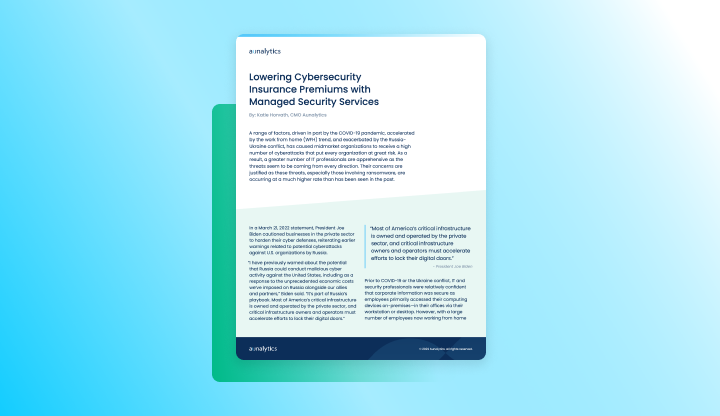
Lowering Cybersecurity Insurance Premiums with Managed Security Services
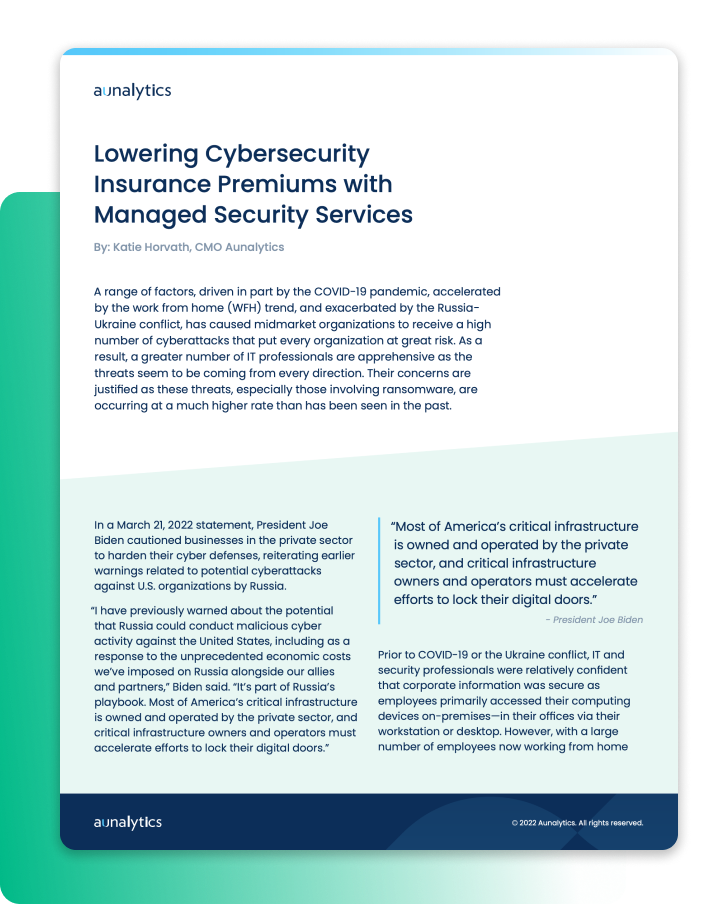
Lowering Cybersecurity Insurance Premiums with Managed Security Services
Midmarket organizations face the threat of cyberattacks that put every organization at great risk. As a result, a greater number of IT professionals are turning to managed security services to lower cybersecurity insurance premiums.
Fill out the form below to receive a link to the article.
Aunalytics is a data platform company. We deliver insights as a service to answer your most important IT and business questions.
Featured Content
Nothing found.
Lowering Cybersecurity Insurance Premiums with Managed Security Services - PDF
Lowering Cybersecurity Insurance Premiums with Managed Security Services
Midmarket organizations face the threat of cyberattacks that put every organization at great risk. As a result, a greater number of IT professionals are turning to managed security services to lower cybersecurity insurance premiums.
Related Content
Nothing found.
How to Assess True Branch Profitability in Mid-Market Banking - PDF
How to Assess True Branch Profitability in Mid-Market Banking
Branch profitability calculations are critically important for branch planning. Traditionally, the branch where a customer opens an account receives credit for that customer’s business. But it’s not always that simple. Learn how analyzing the right data can lead to more accurate results.
Related Content
Nothing found.
Data Scientists Need Usable Data
Data Scientists Need Usable Data
It is a well-known industry problem that data scientists typically spend at least 80% of their time finding and prepping data instead of analyzing it. Learn how a data platform can help mitigate this issue.
Related Content
Nothing found.
The Key to Data-Driven Success for Mid-market Companies Starts Here
The Key to Data-Driven Success for Mid-Market Companies Starts Here
 What’s the #1 pain point for IT professionals? According to the business knowledge resource Insights for Professionals, it’s data center management. With this reality in mind, the foundation of digital transformation success for a data-driven business must begin at the data center level, where servers store your data, CPUs power your computations, and your systems are ideally kept stable, operational, and secure for all users, including those accessing company systems and data from multiple remote locations. Competitive mid-market companies rely on data center engineers who specialize in uptime by proactively preventing downtime, as well as connectivity, storage, security, and monitoring.
Effectively managing data to support accessibility and security requires consistent monitoring and up-to-date solutions. Yet the latest research shows that investing in on-premise infrastructure for data management, compliance, and analytics is too pricey for most mid-market companies — and from the view of many IT directors, on-premise solutions have already morphed into old relics. In 2022, Insights for Professionals reported that nearly two-thirds (63 percent) of senior IT leaders and company executives aren’t planning to attempt to maintain servers on-premise. Instead, the majority of leaders surveyed plan to invest in cloud infrastructure as a service.
Moving into the Future
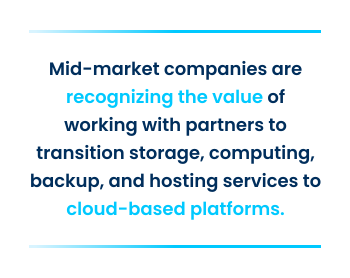 In short, entire businesses are migrating to the cloud, not just the technology. The infinite growth of data, applications, connections, and workloads will only further exacerbate businesses’ ability to adapt to new lines of business applications and platforms, meet security and governance requirements, and seamlessly orchestrate and analyze data for business outcomes. As a result, a growing number of mid-market companies are recognizing the value of working with partners to transition storage, computing, backup, and hosting services to cloud-based platforms to leverage the scale and compute power they can provide.
Gartner reports that by 2025, the vast majority — 85 percent — of enterprises will have already shifted over to a cloud-first approach. How did this changing of the guard occur so quickly? According to Gartner, it can be traced in part to the COVID-19 pandemic, which has accelerated cloud adoption since 2020, ushering it in as the “de facto new normal.” Gartner analysts including Gregor Petri even go so far as to state that “enterprise architecture and technology leaders should reject any new product that does not follow ‘cloud first’ as a guiding principle.”
Mid-Market Essentials

There are solid reasons behind mid-market businesses moving their data out of on-premise environments, particularly due to the efficiencies obtained from cloud-based business applications in multi-cloud and hybrid environments. This brings us back to data center vendors, who must then be ready to absorb the responsibility and cost of infrastructure capital expenses and maintenance — and it looks like many are already prepared to do so. In 2022 alone, nearly one-third (32 percent) of those surveyed by Insights for Professionals were planning to invest heavily in cloud management, to the tune of $500,000, while nearly 30 percent plan to spend even more. The largest part of this cloud management investment is being channeled toward security, with enterprises intending to spend 82 percent of this budget on data protection.
This is not a passing trend and is expected to have long-term consequences for purchase decisions in mid-market companies. By 2023, as scalability and cohesive cloud ecosystems join the ranks among the top three buying considerations for IT, Gartner anticipates that cloud architects will become key stakeholders when choosing tools for analytics and business intelligence. Here’s another surprising statistic to show the direction we’re heading in: while hyper-scale cloud providers (hyper-scalers) delivered and managed less than 1 percent of installed edge computing platforms in 2020, Gartner predicts this number to balloon to 20 percent by the end of 2023.
Different Needs for Mid-Market Players
There’s a catch, though, about hyper-scalers: most are not built for the mid-market. Therefore, mid-market companies won’t be able to reap the maximum benefit from the ability of traditional hyper-scale cloud providers to bring global business solutions, outsourcing, and consulting capabilities that can help other types of organizations migrate to, adopt, and build cloud-native offerings. It’s true that traditional hyper-scalers excel in leveraging the expertise of their cloud professionals to consult for platform re-architecture, application development, data migration, and transitioning services from technology stacks into macro- and microservices hosted in a data center on-premise, private cloud, public cloud (or any multi-cloud or hybrid combination thereof) — but not generally for mid-market companies.
Let’s drill down into some specific problems for mid-market players around hyper-scale cloud providers:
- It can be cost-prohibitive to obtain the level of help that most mid-market companies require, since most hyper-scalers are priced for large enterprises. Mid-market companies tend to need “white glove” services, which carry the highest price tag.
- Greater needs. Enterprises are more likely to already have in-house teams with the necessary skillsets to work with traditional hyper-scalers, compared to mid-market businesses that often have higher needs for expert help.
- No data analytics. While many enterprise hyper-scalers help migrate data to third-party cloud vendor platforms, their services end there, as they don’t offer data analytics.
Mid-market companies need technical experts to help build solutions on a mid-market budget — specifically, they require a hyper-scaler capable of providing an end-to-end solution focused on the mid-market sector. The goal in evaluating potential solutions providers should be for the cloud foundation to operate seamlessly with end-to-end data management and analytics solutions. With an end-to-end solution, mid-market businesses have the opportunity to obtain the results they desire without wasting time on a “Frankenstein” approach, assembling parts and pieces of multiple technologies and tools in an attempt to construct a reliable system that actually works. It’s only by going the end-to-end route that mid-market companies can receive the greater level of assistance they need on the technology front, as well as benefit from the robust data and analytics skillsets necessary to achieve meaningful business outcomes, without paying enterprise prices.
Learn More
Nothing found.
What Mid-Market Companies Need for Data-Driven Success and How to Get It
What Mid-Market Companies Need for Data-Driven Success and How to Get It
Using your data as an asset to drive competitive business growth and achieve cost cutting operational efficiencies is imperative for a company to compete, survive, and thrive. Increasingly, data and analytics have become a primary driver of business strategy and the potential of data-driven business strategies is greater today than ever.
Related Content
Nothing found.
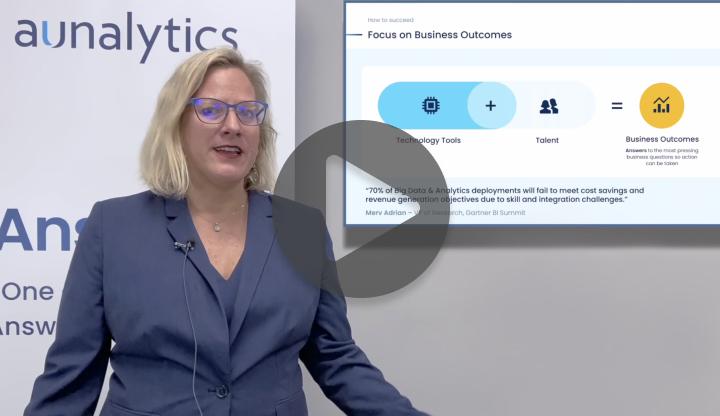
Enhance Customer Experience and Increase Market Share with AI-Driven Personalized Interactions
Enhance Customer Experience and Increase Market Share with AI-Driven Personalized Interactions
Aunalytics CMO Katie Horvath explains how midsized banks and credit unions can enhance the customer or member experience by becoming more data-driven. Employing these strategies can lead to increased revenue, lower expenses, and increased operational efficiencies.
Related Content
Nothing found.

Analytics Database Platform Powers Customer Insights and Positive Outcomes for Community Bank
 Horizon Bank, a midsized community bank with branches across Indiana and Michigan, sought to implement an analytics database platform that would help them make better use of the copious amounts of CRM data they possessed, but had not been able to use to its full potential. Horizon had installed several customer relationship management (CRM) systems over the years that fell short of meeting the organization’s objectives due to a data infrastructure that wasn’t conducive for robust customer relationship management. As a result, the bank made the strategic decision to develop a custom in-house CRM solution and selected the Daybreak™ for Financial Services analytics database platform to enable seamless data integration and utilization of that data for customer relationship management to further strategic business intelligence goals.
Data experts at Aunalytics took a three-pronged approach to solve Horizon Bank’s business challenges using the Daybreak for Financial Services analytics database platform. The first move was to get the data right by converging disparate repositories, and organizing the information for ingestion in the proper application area. Horizon Bank leverages Daybreak’s robust, cloud-native platform to convert data into answers in support of a wide range of business intelligence applications. Daybreak allows Horizon’s executives to view system-wide data from all business units, cleansing and verifying records to provide enriched data for accurate, data-driven decision making. The aggregated data delivers a 360-degree view of customer information including behavioral data, from which the platform’s proprietary AI technology and deep learning models developed by Aunalytics data scientists glean actionable customer intelligence insights.
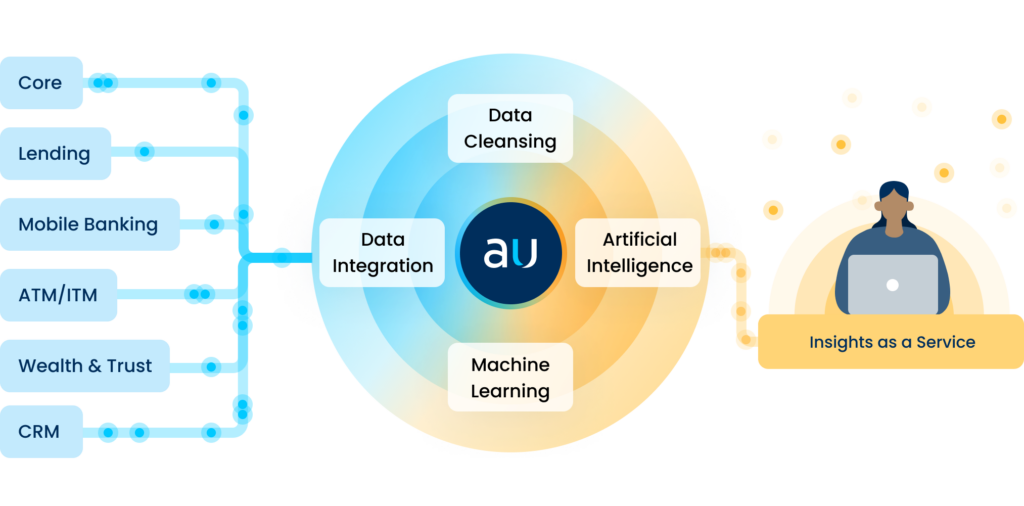
Deploying the Daybreak analytics platform has taken Horizon Bank and its 74 locations to the next level of services and support for customers, making it the preferred financial partner with compelling advantages over larger, competitive establishments. Learn more about the challenges Horizon faced to implement a data analytics platform, and how Daybreak helped them overcome those challenges by downloading the full case study.

The Visible and Invisible Risks of Cryptocurrency for Banks and Credit Unions - PDF
The Visible and Invisible Risks of Cryptocurrency for Banks and Credit Unions
The allure of investing early in the “next big thing” has led to increased interest in crypto investment. As a new industry, it is highly unregulated compared to other types of investments and banking. While there is potential for a big win, there is strong potential for a big lose. As a bank or credit union, here’s what you need to know to protect your institution.
Related Content
Nothing found.