

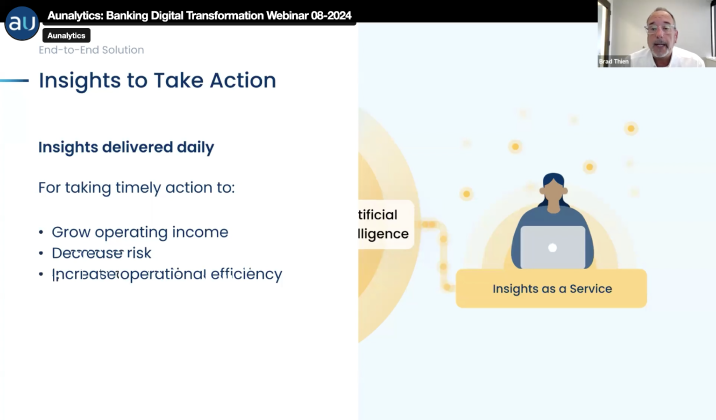
Digital Transformation in Community Banking Webinar
Digital Transformation in Community Banking
With the help of AI technologies, community banks have successfully been able to strengthen relationships, reduce churn, increase deposits, and improve ROI enterprise-wide by utilizing the data they already have at their fingertips—and your organization can, too. However, successful digital transformation can be a major challenge for midsized and community-based banks. Adopting new technologies, shifting operational mindsets, and hiring the talent necessary to build and execute upon AI solutions is a major endeavor. Many banks do not even know where to begin. In this presentation, discuss the steps and considerations for aggregating data across your bank to create a 360-degree view of your customers, why that is important, and ways other community banks have found success through analytics initiatives.



Becoming More Customer-Centric—How Community Banks and Credit Unions Can Cultivate This Mindset and Act on It
Personal, white glove service has always been a competitive advantage for community banks and credit unions. Therefore, a customer-centric mindset is vital. While a customer may be just another number at a large, national bank, community-based financial organizations can get to know people on a more personal level—and they may in turn feel a larger sense of connection and loyalty to a bank or credit union that has a history within the community.
But, as banking moves to be more digitally-focused, a familiar, friendly face at the bank counter is not enough, especially as younger generations embrace the convenience of online and mobile banking. Customer touch points are increasingly digital—which isn’t necessarily a bad thing. Financial institutions now have a wealth of data about each individual. Large, national banks are already using this to their advantage.
Many large financial institutions have invested billions in technology, including data and AI-based solutions that allow them to fully embrace customer centricity in their business practice. This allows them to foster relationships based heavily on digital interactions.
But without ample resources that can be focused on developing data-backed solutions, how can a smaller, community-based institution compete?
Adopting a Customer-First Mindset
While a focus on the customer or member is the bread and butter of most community banks and credit unions, there is always room for improvement. While customer centricity is a sought after ideal, only about 9% of organizations have achieved this goal. This can make it a competitive differentiator for organizations who manage to fully embrace this mindset. To become a truly customer-centric organization, it’s not enough to provide a high level of customer service. It requires customer centricity to be embedded in the organization’s DNA and across all functional areas of the financial institution.
A customer’s interaction with an organization goes beyond the tellers at the branch, or a mobile app’s user interface (though these are each vitally important elements!) There are some questions to consider when evaluating whether an organization is truly putting the customer first:

- Are your products and services what your customers really want and need?
- Are recommendations and advice being tailored to each unique individual?
- Are customers experiencing seamless interactions across all touchpoints?
- Are you using direct feedback and data to inform decision-making?
- Are you able to provide customers with “unexpected value,” beyond what they would normally expect from their financial institution?
In order to reach these lofty goals, organizations must first get buy-in across the organization and actively work to shift goals and mindsets.
Embracing The Power of Data and AI
Once a bank or credit union has determined that it is on its way to cultivating a customer-centric mindset, it is time to start taking action. One of the most powerful ways to become more customer-centric is to rely on insights from data. But the first step is to organize data into a 360-degree view of each customer—breaking down data silos in order to capture the entire customer journey.
Once data has been aggregated, cleansed, and organized around each customer, it can be used to make data-driven decisions, personalize the customer journey, and increase the effectiveness of marketing campaigns, and optimize operations. With the power of AI and predictive analytics, organizations can:
- Enhance digital interactions with chatbots;
- Enact offer relevant product suggestions;
- Determine which customers or members are most likely to churn;
- Identify potential new customers who look the most like their current best customers;
- Optimize loyalty programs to increase customer satisfaction; and more.
Where To Start?
If all of this sounds like a lofty goal, that is because it is. This undertaking can be a huge challenge for most midsized banks and credit unions. In many cases, it could take several months—or even years—to get to this point. That is why many organizations are looking outside their own walls to work with experienced partners to guide them through the process along with pre-built technology solutions that can reduce the time to implementation.
To meet the unique challenges of community banks and credit unions, Aunalytics has developed the Daybreak Analytics Database—an end-to-end data and analytics platform using AI and machine learning to enrich a bank or credit union’s existing data and create a customer-centric view. This ultimately allows midsized financial institutions to more effectively identify and deliver new services and solutions so they can increase wallet share and better compete with large financial institutions.

Organizations Shift to Cloud-Based Analytics and IT Platforms
The growth rates of cloud-based IT solutions in the areas of analytics and artificial intelligence have been substantial in recent years. The increasing volume of data and the need for faster, more accurate insights have driven organizations to adopt cloud-based analytics solutions at a rapid pace. This has resulted in the growth of cloud-based data warehousing, business intelligence, and big data analytics solutions.
Similarly, the growth of artificial intelligence has been driven by the cloud, as it allows organizations to access powerful AI algorithms and training data without having to invest in expensive hardware. The cloud has also made it possible for organizations to scale AI solutions quickly and easily, leading to an increase in the adoption of cloud-based machine learning and deep learning solutions. These trends are expected to continue as organizations look to leverage the power of AI and analytics to gain a competitive edge in the market.

This growth in cloud-based analytics and AI has been driven by the larger business adoption of cloud IT because of its numerous benefits such as increased flexibility, scalability, and cost savings. Cloud technology allows companies to access their data and applications from anywhere, reducing the need for physical infrastructure and freeing up resources for other areas of the business. This shift towards cloud computing has also improved disaster recovery and business continuity, as data can be stored and accessed remotely. Additionally, with the rise of cloud-based solutions, businesses have been able to access advanced technologies and services without having to invest in expensive hardware and software. This has resulted in increased competitiveness, innovation and better overall business performance.
APIs add efficiency and flexibility to cloud environments
The power behind the most widely adopted cloud platforms are APIs (Application Programming Interfaces), which play a crucial role as they allow different software systems to communicate with each other and access data from the cloud. This has enabled organizations to build custom solutions and integrate disparate systems seamlessly, making the use of cloud technology much more efficient and flexible.
APIs also allow for automation and streamlining of processes, reducing manual errors and freeing up time for more valuable tasks. APIs make it possible to add new functionality and services to existing systems, allowing for continuous improvement and innovation. In essence, APIs provide a bridge between the cloud and an organization’s systems, enabling organizations to harness the full potential of cloud computing and drive digital transformation.
Analytics moves to the cloud
In terms of business outcomes, cloud-based analytics allow businesses to access and process large amounts of data in real-time, regardless of the size or location of their operations. This enables organizations to make informed decisions quickly and respond to changing market conditions with agility. Secondly, these solutions are much more cost-effective, as businesses only pay for what they use and do not have to invest in expensive hardware or IT infrastructure. The cloud provides businesses with access to a wide range of advanced analytics tools and technologies, enabling them to gain insights from their data in new and innovative ways. These solutions are highly secure and reliable when they are managed by experienced cloud service providers who ensure that data is protected and the solution is always available. Overall, they are considered to be a better choice for businesses because of their scalability, flexibility, cost-effectiveness, and secure approach to data analysis.
Likewise, cloud-based AI or AI as a Service (AIaaS) provides organizations with access to deep insights without having to invest in expensive experts or the necessary hardware and software to implement such solutions. This makes it easier for organizations to deploy and scale AI solutions as they only pay for what they use and do not have to invest in maintaining their own infrastructure. Furthermore, these solutions are more flexible and can be customized to meet specific business requirements, enabling organizations to generate valuable insights that help them to differentiate from their competitors. Finally, cloud-based AI makes it possible for organizations to collaborate and share AI models, allowing them to leverage the collective expertise of their partners, customers, and employees to create better solutions. In short, it is a high-value choice for businesses as it provides a more accessible, scalable, affordable, and collaborative approach to artificial intelligence.
Moving to the cloud accelerates digital transformation
Leading research and advisory firm Gartner reported that “Cloud migration is not stopping, IaaS will naturally continue to grow as businesses accelerate IT modernization initiatives to minimize risk and optimize costs. Moving operations to the cloud also reduces capital expenditures by extending cash outlays over a subscription term, a key benefit in an environment where cash may be critical to maintain operations.”
Aunalytics provides a highly redundant and scalable cloud infrastructure that enables midsized businesses to reap the benefits of the cloud at a reasonable cost. The Aunalytics Cloud provides a wide range of solutions—including cloud storage, backup and disaster recovery, application hosting, advanced analytics, and AI. Moving from on-premises computing to a cloud environment is a key step in an organization’s digital transformation.

Investment in Artificial Intelligence is Vital for Banks and Credit Unions
Has your bank or credit union made investments in artificial intelligence yet?
Advances in artificial intelligence (AI), and the promise it holds for the future, have been making news all year. And it’s no wonder that financial institutions are taking notice—a recent survey from the Economist Intelligence Unit found that 77% of bankers believe that unlocking value from AI will be the differentiator between winning and losing banks. Yet, many institutions are falling behind in AI maturity.
Despite its promise, making a large investment in artificial intelligence may seem risky to many midsized financial institutions. Hiring talent, developing a data management and analytics strategy, building a data platform, and creating AI models can be both time- and resource-intensive. Banks and credit unions want to ensure that the efforts spent to get an AI program off the ground will yield a high ROI, especially in times of economic uncertainty. Yet, failure to innovate and make progress toward digital transformation is not always an option in the highly competitive landscape.

Financial institutions find many uses for AI technologies
Thankfully, an investment in artificial intelligence can improve many processes across an institution. AI can optimize both time- and resource-intensive tasks, decrease risk, and increase revenue by improving the customer experience. For instance, by applying AI and machine learning algorithms to transactional data, banks and credit unions can gain insights into customers or members’ habits and preferences. Some use cases include:
- Detecting and preventing fraud
- Identifying loan default risk at the time of application
- Predicting customer churn
- Winning back business by discovering customer payments going to competitors, and subsequently making a more attractive offer
- Predicting the next best product for each customer then targeting them with the right product at the right time
- Calculating customer value scores in order to better allocate resources to target more valuable customers
Don’t get left behind
Large banks are already utilizing artificial intelligence use cases at scale. In a recent letter to shareholders, Jamie Dimon, Chief Executive Officer of JPMorgan Chase wrote, “Artificial intelligence (AI) is an extraordinary and groundbreaking technology. AI and the raw material that feeds it, data, will be critical to our company’s future success—the importance of implementing new technologies simply cannot be overstated.”
Because of this focus, his company has made tremendous investments in AI. They currently have over 300 AI use cases in production, and employ almost 3,000 people in data management, data science, and AI-research-related roles. This underscores how vital these new technologies are to success in the future.
Unfortunately, not every institution has access to talent and technology at the scale of JPMorgan Chase. That’s why Aunaytics has developed a cloud-based data and analytics platform to provide data management, advanced reporting, and predictive AI and machine learning solutions for midsized community banks and credit unions.
Daybreak for Financial Services allows institutions to learn more about their customers and members in order to provide a better overall experience—which in turn reduces risk, increases wallet share, and reduces expenses.

The Truth About Artificial Intelligence in Business
Is the existence of Skynet imminent or is that simply a sci-fi trope? In this brief video, Dr. David Cieslak, Chief Data Scientist at Aunalytics, talks about the capabilities of Artificial Intelligence in business, some potential concerns with AI, and where the technology is headed in the future.
While there exists a broad range of applications for AI, in the business world, this technology has the potential to drastically change how we understand our customers and how we use our data to interact with them. Once created and trained with customer data, AI has the ability to quickly provide suggestions and insights that would otherwise be prohibitively difficult or even impossible to observe on your own.
For example, Aunalytics’ Daybreak for Financial Institutions platform uses a proprietary AI model that can predict when a customer or member is likely to churn, to suggest which product to promote based on what that specific person is most likely to buy, to identify where the best branch locations are, and more. These types of insights are hiding in your data, simply waiting to be uncovered. To learn more about the business applications of AI, you can view the extended interview here.
David Cieslak, PhD, is the Chief Data Scientist at Aunalytics since its inception and leads its Innovation Lab in the development and delivery of complex algorithms designed to solve business problems in the manufacturing/supply chain, financial, healthcare, and media sectors. Prior to Aunalytics, Cieslak was on staff at the University of Notre Dame as part of the research faculty where he contributed on high value grants with both the federal government and Fortune 500 companies. He has published numerous articles in highly regarded journals, conferences, and workshops on the topics of Machine Learning, Data Mining, Knowledge Discovery, Artificial Intelligence, and Grid Computing.
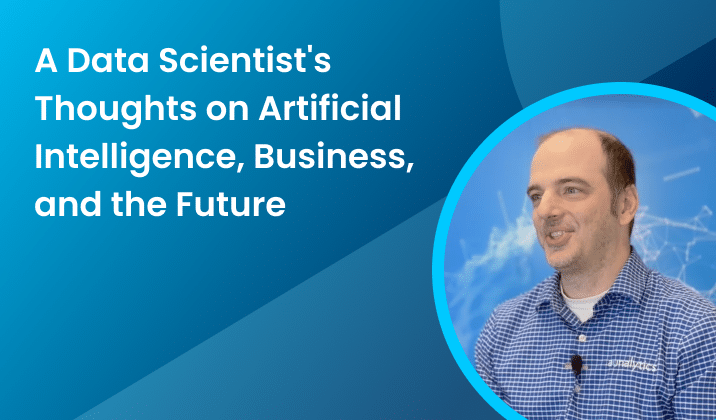
A Data Scientist's Thoughts on Artificial Intelligence, Business, and the Future
A Data Scientist's Thoughts on Artificial Intelligence, Business, and the Future
In this interview, David Cieslak, PhD, the Chief Data Scientist at Aunalytics, describes complex analytics concepts such as artificial intelligence, machine learning, and deep learning, and explains how they are useful for businesses today—and will continue to be in the future. David has been with Aunalytics since its inception and leads its Innovation Lab in the development and delivery of complex algorithms designed to solve business problems in the manufacturing/supply chain, financial, healthcare, and media sectors.
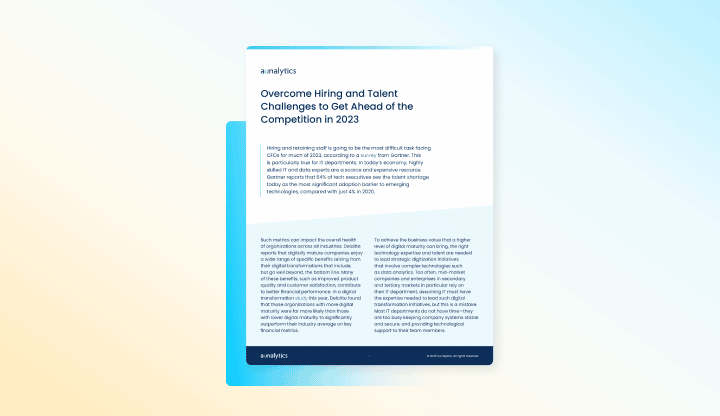
Overcome Hiring and Talent Challenges to Get Ahead of the Competition in 2023
Overcome Hiring and Talent Challenges to Get Ahead of the Competition in 2023
Hiring and retaining staff is going to be the most difficult task facing CFOs for much of 2023. This is particularly true for IT departments. In today’s economy, highly skilled IT and data experts are a scarce and expensive resource. The mid-market organization requires another option that provides access to the right tools, resources, and support.
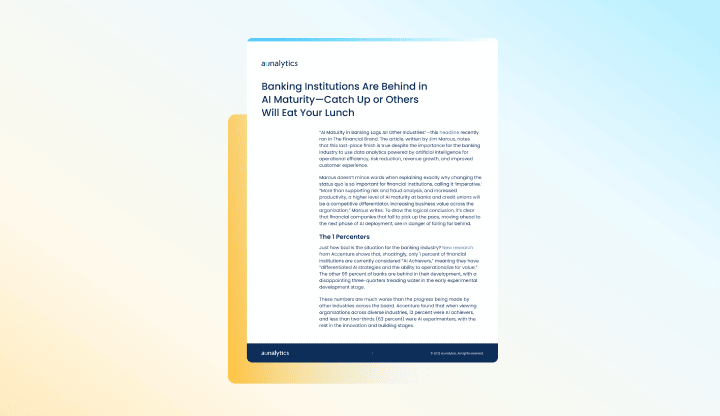
Banking Institutions Are Behind in AI Maturity—Catch Up or Others Will Eat Your Lunch
Banking Institutions Are Behind in AI Maturity—Catch Up or Others Will Eat Your Lunch
Financial institutions must embrace the use of data analytics powered by artificial intelligence for operational efficiency, risk reduction, revenue growth, and improved customer experience. Yet, it’s clear that financial companies that fail to pick up the pace, moving ahead to the next phase of AI deployment, are in danger of falling far behind. Luckily, there is a clear-cut solution to reaching AI maturity and achieving sustained, long-term success.
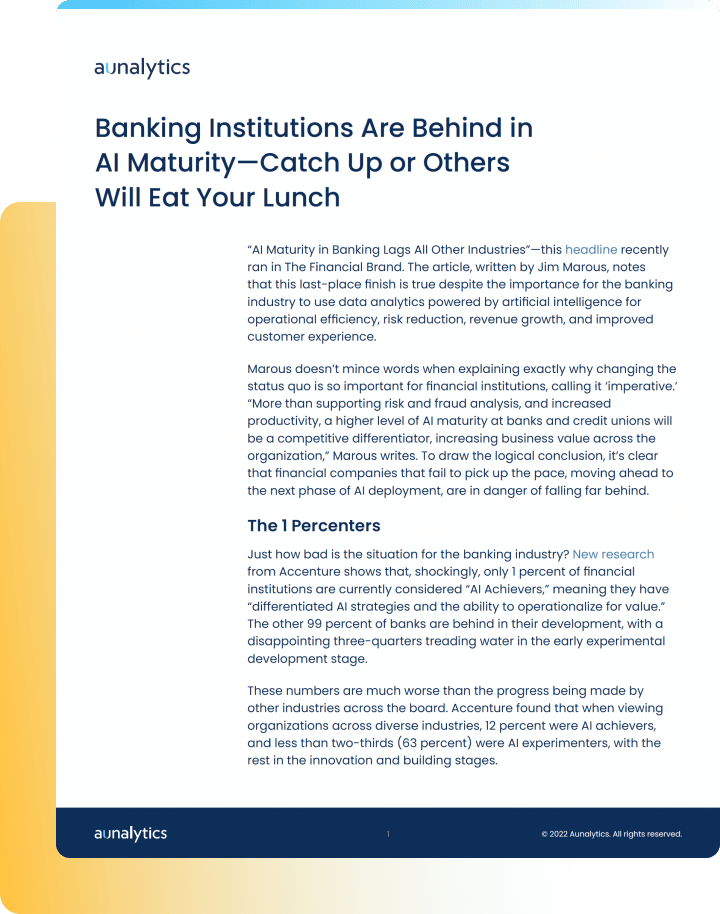
Fill out the form below to receive a link to the article.
Banking Institutions Are Behind in AI Maturity—Catch Up or Others Will Eat Your Lunch
Banking Institutions Are Behind in AI Maturity—Catch Up or Others Will Eat Your Lunch
Financial institutions must embrace the use of data analytics powered by artificial intelligence for operational efficiency, risk reduction, revenue growth, and improved customer experience. Yet, it’s clear that financial companies that fail to pick up the pace, moving ahead to the next phase of AI deployment, are in danger of falling far behind. Luckily, there is a clear-cut solution to reaching AI maturity and achieving sustained, long-term success.

The Value of Data Visualization
In this brief video, Dr. David Cieslak, Chief Data Scientist at Aunalytics, discusses the value that data visualization brings to data analytics. Whether you’re using a simple tool such as Excel or a BI software such as Tableau, creating a visual representation of your data allows it to be consumed by a much broader and less technical audience. Whether you’re a marketing specialist, a loan officer, or a bank president, a well-designed and up-to-date dashboard greatly improves your ability to understand and work with your data in a way that lists and spreadsheets can’t.
Aunalytics’ Daybreak Dashboards for Financial Institutions offer a variety of data visualization options such as the Customer Profile dashboard, which provides a 360-degree view of each customer, the Lending KPI dashboard, which provides overall and detailed lending performance across your organization, and the Marketing KPI dashboard, which allows for targeted campaigns to reach the right customer at the right time with the right product. With Aunalytics, you get the technology and the expertise required to turn your disparate data into easily understandable insights through the Daybreak Dashboards.
David Cieslak, PhD, is the Chief Data Scientist at Aunalytics since its inception and leads its Innovation Lab in the development and delivery of complex algorithms designed to solve business problems in the manufacturing/supply chain, financial, healthcare, and media sectors. Prior to Aunalytics, Cieslak was on staff at the University of Notre Dame as part of the research faculty where he contributed on high value grants with both the federal government and Fortune 500 companies. He has published numerous articles in highly regarded journals, conferences, and workshops on the topics of Machine Learning, Data Mining, Knowledge Discovery, Artificial Intelligence, and Grid Computing.