


Becoming More Customer-Centric—How Community Banks and Credit Unions Can Cultivate This Mindset and Act on It
Personal, white glove service has always been a competitive advantage for community banks and credit unions. Therefore, a customer-centric mindset is vital. While a customer may be just another number at a large, national bank, community-based financial organizations can get to know people on a more personal level—and they may in turn feel a larger sense of connection and loyalty to a bank or credit union that has a history within the community.
But, as banking moves to be more digitally-focused, a familiar, friendly face at the bank counter is not enough, especially as younger generations embrace the convenience of online and mobile banking. Customer touch points are increasingly digital—which isn’t necessarily a bad thing. Financial institutions now have a wealth of data about each individual. Large, national banks are already using this to their advantage.
Many large financial institutions have invested billions in technology, including data and AI-based solutions that allow them to fully embrace customer centricity in their business practice. This allows them to foster relationships based heavily on digital interactions.
But without ample resources that can be focused on developing data-backed solutions, how can a smaller, community-based institution compete?
Adopting a Customer-First Mindset
While a focus on the customer or member is the bread and butter of most community banks and credit unions, there is always room for improvement. While customer centricity is a sought after ideal, only about 9% of organizations have achieved this goal. This can make it a competitive differentiator for organizations who manage to fully embrace this mindset. To become a truly customer-centric organization, it’s not enough to provide a high level of customer service. It requires customer centricity to be embedded in the organization’s DNA and across all functional areas of the financial institution.
A customer’s interaction with an organization goes beyond the tellers at the branch, or a mobile app’s user interface (though these are each vitally important elements!) There are some questions to consider when evaluating whether an organization is truly putting the customer first:

- Are your products and services what your customers really want and need?
- Are recommendations and advice being tailored to each unique individual?
- Are customers experiencing seamless interactions across all touchpoints?
- Are you using direct feedback and data to inform decision-making?
- Are you able to provide customers with “unexpected value,” beyond what they would normally expect from their financial institution?
In order to reach these lofty goals, organizations must first get buy-in across the organization and actively work to shift goals and mindsets.
Embracing The Power of Data and AI
Once a bank or credit union has determined that it is on its way to cultivating a customer-centric mindset, it is time to start taking action. One of the most powerful ways to become more customer-centric is to rely on insights from data. But the first step is to organize data into a 360-degree view of each customer—breaking down data silos in order to capture the entire customer journey.
Once data has been aggregated, cleansed, and organized around each customer, it can be used to make data-driven decisions, personalize the customer journey, and increase the effectiveness of marketing campaigns, and optimize operations. With the power of AI and predictive analytics, organizations can:
- Enhance digital interactions with chatbots;
- Enact offer relevant product suggestions;
- Determine which customers or members are most likely to churn;
- Identify potential new customers who look the most like their current best customers;
- Optimize loyalty programs to increase customer satisfaction; and more.
Where To Start?
If all of this sounds like a lofty goal, that is because it is. This undertaking can be a huge challenge for most midsized banks and credit unions. In many cases, it could take several months—or even years—to get to this point. That is why many organizations are looking outside their own walls to work with experienced partners to guide them through the process along with pre-built technology solutions that can reduce the time to implementation.
To meet the unique challenges of community banks and credit unions, Aunalytics has developed the Intelligent Data Warehouse—an end-to-end data and analytics platform using AI and machine learning to enrich a bank or credit union’s existing data and create a customer-centric view. This ultimately allows midsized financial institutions to more effectively identify and deliver new services and solutions so they can increase wallet share and better compete with large financial institutions.


Investment in Artificial Intelligence is Vital for Banks and Credit Unions
Has your bank or credit union made investments in artificial intelligence yet?
Advances in artificial intelligence (AI), and the promise it holds for the future, have been making news all year. And it’s no wonder that financial institutions are taking notice—a recent survey from the Economist Intelligence Unit found that 77% of bankers believe that unlocking value from AI will be the differentiator between winning and losing banks. Yet, many institutions are falling behind in AI maturity.
Despite its promise, making a large investment in artificial intelligence may seem risky to many midsized financial institutions. Hiring talent, developing a data management and analytics strategy, building a data platform, and creating AI models can be both time- and resource-intensive. Banks and credit unions want to ensure that the efforts spent to get an AI program off the ground will yield a high ROI, especially in times of economic uncertainty. Yet, failure to innovate and make progress toward digital transformation is not always an option in the highly competitive landscape.

Financial institutions find many uses for AI technologies
Thankfully, an investment in artificial intelligence can improve many processes across an institution. AI can optimize both time- and resource-intensive tasks, decrease risk, and increase revenue by improving the customer experience. For instance, by applying AI and machine learning algorithms to transactional data, banks and credit unions can gain insights into customers or members’ habits and preferences. Some use cases include:
- Detecting and preventing fraud
- Identifying loan default risk at the time of application
- Predicting customer churn
- Winning back business by discovering customer payments going to competitors, and subsequently making a more attractive offer
- Predicting the next best product for each customer then targeting them with the right product at the right time
- Calculating customer value scores in order to better allocate resources to target more valuable customers
Don’t get left behind
Large banks are already utilizing artificial intelligence use cases at scale. In a recent letter to shareholders, Jamie Dimon, Chief Executive Officer of JPMorgan Chase wrote, “Artificial intelligence (AI) is an extraordinary and groundbreaking technology. AI and the raw material that feeds it, data, will be critical to our company’s future success—the importance of implementing new technologies simply cannot be overstated.”
Because of this focus, his company has made tremendous investments in AI. They currently have over 300 AI use cases in production, and employ almost 3,000 people in data management, data science, and AI-research-related roles. This underscores how vital these new technologies are to success in the future.
Unfortunately, not every institution has access to talent and technology at the scale of JPMorgan Chase. That’s why Aunaytics has developed a cloud-based data and analytics platform to provide data management, advanced reporting, and predictive AI and machine learning solutions for midsized community banks and credit unions.
Auna, the AI Agent for Financial Institutions, allows institutions to learn more about their customers and members in order to provide a better overall experience—which in turn reduces risk, increases wallet share, and reduces expenses.
The Truth About Artificial Intelligence in Business
Is the existence of Skynet imminent or is that simply a sci-fi trope? In this brief video, Dr. David Cieslak, Chief Data Scientist at Aunalytics, talks about the capabilities of Artificial Intelligence in business, some potential concerns with AI, and where the technology is headed in the future.
While there exists a broad range of applications for AI, in the business world, this technology has the potential to drastically change how we understand our customers and how we use our data to interact with them. Once created and trained with customer data, AI has the ability to quickly provide suggestions and insights that would otherwise be prohibitively difficult or even impossible to observe on your own.
David Cieslak, PhD, is the Chief Data Scientist at Aunalytics since its inception and leads its Innovation Lab in the development and delivery of complex algorithms designed to solve business problems in the manufacturing/supply chain, financial, healthcare, and media sectors. Prior to Aunalytics, Cieslak was on staff at the University of Notre Dame as part of the research faculty where he contributed on high value grants with both the federal government and Fortune 500 companies. He has published numerous articles in highly regarded journals, conferences, and workshops on the topics of Machine Learning, Data Mining, Knowledge Discovery, Artificial Intelligence, and Grid Computing.
A Data Scientist's Thoughts on Artificial Intelligence, Business, and the Future
A Data Scientist's Thoughts on Artificial Intelligence, Business, and the Future
In this interview, David Cieslak, PhD, the Chief Data Scientist at Aunalytics, describes complex analytics concepts such as artificial intelligence, machine learning, and deep learning, and explains how they are useful for businesses today—and will continue to be in the future. David has been with Aunalytics since its inception and leads its Innovation Lab in the development and delivery of complex algorithms designed to solve business problems in the manufacturing/supply chain, financial, healthcare, and media sectors.

Do you have the tools and talent to set your organization up for analytics success?
Most business leaders would agree: data is a valuable asset. Having up-to-date, accurate data with which to make data-driven decisions currently gives organizations an edge, but eventually, this will become table stakes in most industries, simply to remain competitive. However, an up-front investment in a strong technical foundation and a shift to embrace analytics culture throughout the organization are required to achieve analytics success.

Unfortunately, there are many challenges to overcome when trying to bring siloed and dirty data from multiple sources across your business to a single place to be analyzed, including a lack of time and manpower, and the need for data points that don’t currently exist, to name a few. Using data analytics, it becomes possible to better optimize your business by discovering operational efficiencies, reducing costs, tracking customer trends across your organization, and making strategic decisions based on predictive data models. Is partnering with analytics experts the best choice for mid-sized institutions, or should you hire Full-Time Employees (FTEs) to build and manage your data?
There are multiple ways an analytics platform could be created—we’re going to look at two today.
Build it yourself
The first is choosing to create a custom data platform. While not a bad choice, it could take a FTE years to create your analytics platform—if it’s ever finished. An engineer hired to build a custom platform may leave you high and dry with no one to step in to help. Something like this could cost your business months—or even years—of lost money and productivity, leaving you with nothing to show for your platform building efforts.
Even if your data engineer remains with your business, there are other challenges you may encounter. It can be difficult for a single FTE to stay up to date on the newest technological advances and upgrades. Especially when that person is not only expected to clean and update information on thousands of data records, but also take care of system and software updates, keep up with changing trends in the analytics world, and more. A lack of manpower can also make tasks like finding trends in your data nearly impossible, as data processing may be far behind where your most recent and relevant business analytics can be found.
When it comes to advanced analytics, you would need to find and hire additional employees who are skilled in advanced data analytics, machine learning, and AI techniques, and ideally, familiar with your industry. This can be easier said than done. Data scientists, like many in the technology field, are in high demand, and may be difficult to find and hire in smaller geographical markets.
Work with a partner
A different option is working with a trusted technology partner who brings data analytics expertise straight to you. Partnering with an end-to-end provider often saves your company money while allowing someone else to take care of the nitty gritty that goes into creating reports, graphs, charts, and more. Additionally, you are guaranteed to have access to the team you need to build algorithms and find insights in your data. A partner will consistently provide you with the right tools, talent, and resources, while supporting you the entire way. But how could an Analytics as a Service partner help you find the true value of your data?
A good partner will be able to offer the required resources to achieve analytics success—a foundational data platform, automated data management, access to data experts, and data delivery methods such as relevant and actionable dashboards and reports. Imagine having a regular report, generated overnight, every night, for you to review first thing in the morning—without having to invest in many new FTEs and years of development time.
When looking for a data analytics partner, all the things above are important for creating a successful partnership that leads to analytics success. Aunalytics provides data processing and analytics help and would never expect you to go it alone. When you hire us, you hire data scientists, data engineers, and data analysts, reducing the need for multiple expensive FTEs. By having access to a team of data experts by your side, your business can find itself enabled to make better, faster, and smarter decisions based on consistent, real-time data.
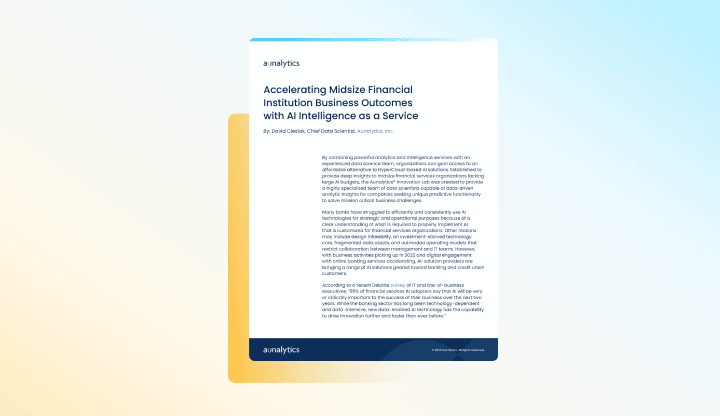
Accelerating Midsize Financial Institution Business Outcomes with AI Intelligence as a Service
Accelerating Midsize Financial Institution Business Outcomes with AI Intelligence as a Service
Many financial institutions have struggled to efficiently and consistently use AI technologies for strategic and operational purposes. To meet this need, the Aunalytics® Innovation Lab was established to provide deep insights to midsize financial services organizations lacking large AI budgets. This combination of powerful analytics and intelligence services with an experienced data science team allows organizations to gain access to an affordable alternative to HyperCloud-based AI solutions.
Related Content
Nothing found.

Unlocking the Value of Data Analytics: What Mid-Market Companies Need to Understand
Unlocking the Value of Data Analytics: What Mid-Market Companies Need to Understand
 Most mid-market companies make one mistake or another when investing in a data analytics platform, not understanding the many intricacies associated with preparing their data to get the best results. Some of the most common mistakes include:
- Not realizing they need to build pipelines to get the data from their multiple data sources to the analytics platform
- Tasking IT with implementing a data analytics solution, when the IT department does not have data science skillsets
- Basing analytics on data that is riddled with errors, incomplete, or stale, which compromises quality of decision-making due to the inaccuracy and tardiness of the underlying data.
- Relying on the reporting function of one data source and not taking into account data beyond that source for decision-making
- Using dashboards that provide insights into the past only, and not the future – a gap that needs to be bridged to compete with larger enterprises
It should also be noted that analytics requires massive storage and compute to mine data for actionable insights. Even in a cloud environment, which is less costly to maintain than on-premise servers, data analytics takes up a huge amount of compute to mine transactional data for AI-driven insights. Most data warehouses used by mid-market companies are not built for analytics, and their contracts with public cloud vendors for data storage often incur huge overage charges for compute spikes as millions of calculations are being completed for algorithms to converge for analytics results. Data analytics needs a cloud built for analytics. The mid-market should demand a built-in analytics cloud from an analytics solution, without a third-party public cloud contract to make it work (or attempt to host it in their regular institution data storage).
Industry Knowledge is Key
One of the most important aspects to understand is that there is no one-size-fits-all when it comes to data analytics. The value lies in industry specific data models, which must be built with algorithms using salient data points for a specific industry and appropriately weighted for that industry. For example, to build customer revenue in financial services, mining transactional banking data is important to reveal if a customer is doing business with competing financial institutions so that action can be taken to win this business over. In manufacturing, comparing product inventory at various channels and channel or retail sales locations is important for discerning sales performance and growth opportunities. In healthcare, mining insurance reimbursement claims for underpayments to recapture lost revenue requires comparisons of contracted amounts and fee schedules for multiple private insurance companies, plan coverages, and more. The true business value of analytics lies in industry specific data models and the data enrichment made possible by deep learning and the generation of actionable insights.
The Importance of Having the Right Expertise
This brings us to the requirement for data scientists and business analysts, which assist with achieving powerful and current actionable insights that lead to AI-driven decision-making and better business outcomes. Data scientists build algorithms to detect trends, patterns and predictions based upon the data, to position an enterprise for the future. Business analysts are industry specific and connect the dots between the data points relevant for answering business questions in that particular industry. They also help to design dashboards and other data visualizations to ensure that the insights generated answer questions important to that industry using industry-specific terminology, and analyze analytics results in the context of industry knowledge to reveal growth drivers and other opportunities for driving revenue. Typical IT departments do not have these skill sets.
Data Analytics Platform Requirements
Consider these questions when evaluating a data analytics platform:
- Which data sources are forming the basis for the insights: Is the analysis based upon only some of the data, leaving out important data sources? Do the analytics use the most important data points? Is too much data or the wrong data being used?
- How is the data cleansed for accuracy: To judge the accuracy of the insights, know what is being done to eliminate errors in the underlying data being analyzed. Garbage in leads to exponential garbage out when data is turned over to AI. Can the data be trusted?
- Which algorithms are being used to find insights: Is it a specialized or generic deep learning model? Is it optimized for the type of inquiry or result being sought? Is it tailored to a specific industry and weighted appropriately for that industry and the question posed? Can the results be trusted?
- Are the analytics results providing actionable insights such as how to grow revenue, improve efficiency or achieve other business outcomes? Are the results tied to solving business challenges, and not just AI for the sake of being cool?
Side-by-Side Approach
 Most mid-market companies are not in the business of IT or data science. IT is a necessary administrative function for operating a business, but should not become the main focus of most non-tech mid-market companies. However, given the expertise needed to use and maintain most analytics solutions, and the cost of data expert professionals as FTEs, the cost of data management and analytics can quickly overtake mainline business COGS expenses. Given all the complexities and challenges associated with unlocking the true value of data analytics, a new approach is needed that mid-market businesses can afford, enabling them to leverage AI-driven analytics and more effectively compete.
A side-by-side service model offers an alternative that goes beyond most tools and platforms on the market by providing a data platform with built-in data management and analytics, as well as access to human intelligence in data engineering, machine learning, and business analytics. Ideally it should operate as a cloud-based platform with a subscription service that places the burden of the data engineering expertise, technical tooling, and building and maintaining the infrastructure on the data management provider.
While many companies offer tools, and many consulting firms can provide guidance in choosing and implementing the tools, integration of all the tools and expertise in one end-to-end solution built for non-technical business users is key for digital transformation success for midmarket businesses.




Marketing pitfalls can damage customer relationships—here's how to avoid them
While the main goal of marketing is to gain new customers or increase spend from existing customers, at times, marketing effort can do more harm than good. Unfortunately, a marketing campaign could not only fail to entice customers, but certain pitfalls could actively damage customer relationships. Fortunately, there are ways to avoid them. Below are three major mistakes that marketers are prone to making.
#1 Duplicate Mailers
 There is nothing more frustrating than opening up the mailbox and receiving multiple duplicate postcard mailers from a single company. Or when they are addressed to you using two variations or spellings of your name. Or when one is addressed to another member of your household and the second to you. Even worse, when one is addressed to you and another to a generic “household” at your address. Your household typically does not require more than one.
This leaves you to focus on the wasted paper and postage instead of the product or service being marketed. And if the company sending the mailer knew more about the target customer, perhaps the target is someone who does not respond well to snail mail and doesn’t like it. Mailed promotional materials go straight into the recycling bin without even entering houses in many households. This type of waste would be avoided by intel on channel preference of prospects.
When you receive duplicate mailings from a company that you do not do business with currently, it can be viewed as a sign that the customer experience would lack attention to detail, personalization and efficiency. This is a turnoff. That company is likely to be put on a mental list of those you do not want to do business with – period.
If a company that you are doing business with sends multiple duplicative mailers to your home, this can be even worse. In this digital world, many businesses ask customer profile questions including preferred contact method. If you opt in for electronic communications and e-bills, sending a mailer shows that the company is either not listening to its customers or the company is not communicating well within its internal teams. You took the time to complete the profile, yet the business can’t be bothered with using your input. Did anyone read your form fill results? Again, this shows lack of personalized customer experience, inefficiency and lack of cohesiveness in operations. As a current customer, you feel even more devalued than the business that does not have a relationship with you.
Sometimes the duplicate mailings are sent to your name using slight variations of your address, such as “Street” versus “St.” If the business cleaned up its mailing list and recognized that this is the same location, it would save on operational costs and make the company look smarter.
#2 Marketing Products to Customers Who Just Bought Them
A second frustration is receiving a mailer from a company that you currently do business with asking you to purchase products or services that you already have purchased from them. For example, a bank sends a mailer to open a HELOC account or a credit card account when you already have that product from that bank. Is the bank carpet bombing mailings to everyone? How wasteful. Is it that the bank does not care enough about you as a customer to take the time to realize which products you already have with them?
The misdirected marketing may cause customers to begin to think that they should place their business with a bank that cares about their business enough to know which accounts a customer has with them. Really, the relationship would be better if the bank stopped trying to engage its customers than continue to do so with communications that miss the mark.
#3 Bad Timing
A third pet peeve with marketing is when the offers are untimely. For example, if you just refinanced your mortgage with your bank, the bank should not send you a mailer 10 days later for a refinancing opportunity. Yes, customers appreciate notification of interest rates becoming more favorable. But given that you just paid closing costs (or folded them into your loan), refinancing 10 days later is not likely. Instead, you run the risk that the customer sees even better terms being offered and feels dissatisfied with his new product or even mad. From the customer’s perspective, if the bank had told him to wait 10 days, he’d have better terms. Marketing can do better on timing.
Marketing should not damage customer relations.
The Digital Data Challenge
Many businesses have a plethora of data that is typically siloed across many systems throughout the organization. Aggregating and integrating this data for marketing purposes is a major challenge that can be difficult and time-consuming, if not nearly impossible.
Hyper-personalized services that factor in intelligence about a customer holistically should form the core of customer relationships. To achieve this goal, businesses can integrate their disparate data architecture across lines of business and functions to create a 360-degree view of customers and allow for targeted marketing based upon data.
New and advanced data analytics powered by artificial intelligence (AI) are available today that enable customer intelligence to drive marketing. Aggregate your data and ensure that it is cleansed to remove duplicate customer lists for mailings. AI-powered analytics recognizes when people with different names are part of the same household to further eliminate duplicate mailings.
Harness the power of your data to personalize a customer’s experience with your company and not only avoid these pitfalls, but enable smarter targeted marketing.

Data Analytics Helps Midsize Financial Institutions Thrive
 The financial services industry continues to rapidly evolve. Between mergers, changing customer demographics, and increasing reliance on digital platforms for banking interactions, it can be difficult for smaller institutions to compete with large, national, and online-only banks in this crowded market. As customer interactions become increasingly digital, community and mid-market banks and credit unions are challenged with maintaining the competitive advantage that local, personalized, white-glove service has traditionally afforded them. This is why customer intelligence powered by data analytics helps midsize banks and credit unions thrive. However, they oftentimes struggle to achieve the valuable business insights that untapped data could provide to improve their operations.
It is unlikely that midsize and community banks will “out tech” large banks and fin-techs on their own. However, with the right partners, they have an opportunity to thrive by redefining the local experience and digitally transforming how they operate. Using the right data analytics, they can leverage their local knowledge with personalized customer intelligence to regain competitive advantage.
Customer Intelligence within Reach
Auna offers the ability to target, discover and offer the right services to the right people, at the right time. Built from the ground up for midsize community banks and credit unions, Auna is powered by the Intelligent Data Warehouse. The solution cleanses data for accuracy, ensures data governance across the organization, and employs AI and machine learning (ML) driven analytics to glean customer intelligence and insights from volumes of transactional data created in the business and updated daily. The daily insights and industry intelligence enable a variety of analytics solutions for fast, easy access to credible data, users can find the answers to such questions as:
- Which current customers that have a loan but not a deposit account?
- Who has a mortgage or wealth account with one of my competitors?
- Which customers with a credit score above 700 are most likely to open a HELOC?
- Which loans were modified from the previous day?
- Who are current members with a HELOC that are utilizing less than 25% of their line of credit?
Harnessing their data with Auna enables community banks and credit unions to discover patterns, insights, trends, and usage strategies helps to strengthen their position in regional markets and compete with large national banks. With Aunalytics, they are enabled to deliver timely personalized messages to customers, make data-driven product recommendations, measure campaign ROI, and grow net dollar retention.