

Organizations Shift to Cloud-Based Analytics and IT Platforms
The growth rates of cloud-based IT solutions in the areas of analytics and artificial intelligence have been substantial in recent years. The increasing volume of data and the need for faster, more accurate insights have driven organizations to adopt cloud-based analytics solutions at a rapid pace. This has resulted in the growth of cloud-based data warehousing, business intelligence, and big data analytics solutions.
Similarly, the growth of artificial intelligence has been driven by the cloud, as it allows organizations to access powerful AI algorithms and training data without having to invest in expensive hardware. The cloud has also made it possible for organizations to scale AI solutions quickly and easily, leading to an increase in the adoption of cloud-based machine learning and deep learning solutions. These trends are expected to continue as organizations look to leverage the power of AI and analytics to gain a competitive edge in the market.
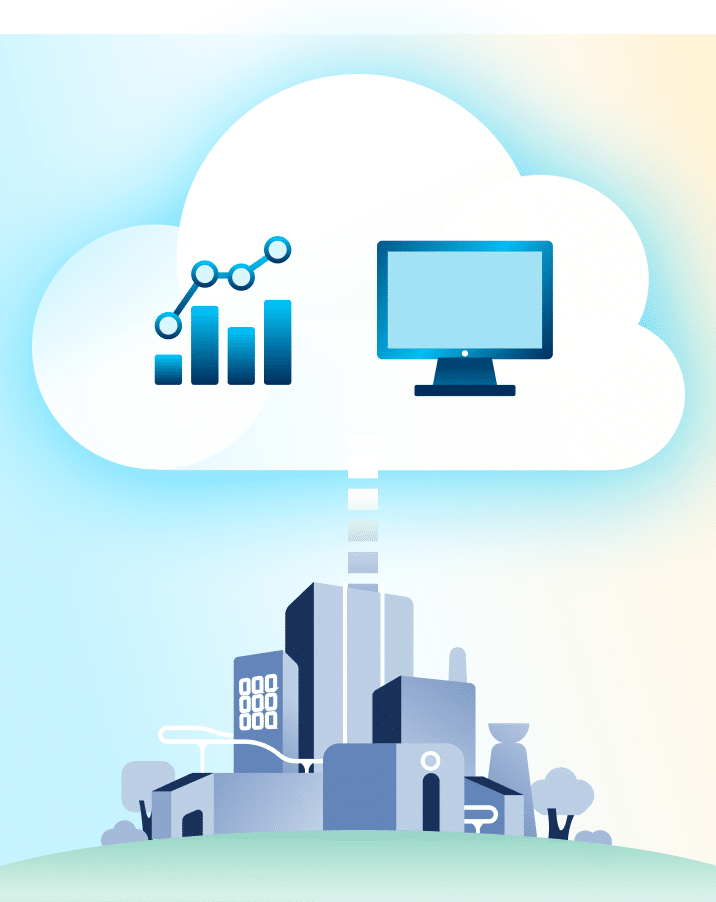
This growth in cloud-based analytics and AI has been driven by the larger business adoption of cloud IT because of its numerous benefits such as increased flexibility, scalability, and cost savings. Cloud technology allows companies to access their data and applications from anywhere, reducing the need for physical infrastructure and freeing up resources for other areas of the business. This shift towards cloud computing has also improved disaster recovery and business continuity, as data can be stored and accessed remotely. Additionally, with the rise of cloud-based solutions, businesses have been able to access advanced technologies and services without having to invest in expensive hardware and software. This has resulted in increased competitiveness, innovation and better overall business performance.
APIs add efficiency and flexibility to cloud environments
The power behind the most widely adopted cloud platforms are APIs (Application Programming Interfaces), which play a crucial role as they allow different software systems to communicate with each other and access data from the cloud. This has enabled organizations to build custom solutions and integrate disparate systems seamlessly, making the use of cloud technology much more efficient and flexible.
APIs also allow for automation and streamlining of processes, reducing manual errors and freeing up time for more valuable tasks. APIs make it possible to add new functionality and services to existing systems, allowing for continuous improvement and innovation. In essence, APIs provide a bridge between the cloud and an organization’s systems, enabling organizations to harness the full potential of cloud computing and drive digital transformation.
Analytics moves to the cloud
In terms of business outcomes, cloud-based analytics allow businesses to access and process large amounts of data in real-time, regardless of the size or location of their operations. This enables organizations to make informed decisions quickly and respond to changing market conditions with agility. Secondly, these solutions are much more cost-effective, as businesses only pay for what they use and do not have to invest in expensive hardware or IT infrastructure. The cloud provides businesses with access to a wide range of advanced analytics tools and technologies, enabling them to gain insights from their data in new and innovative ways. These solutions are highly secure and reliable when they are managed by experienced cloud service providers who ensure that data is protected and the solution is always available. Overall, they are considered to be a better choice for businesses because of their scalability, flexibility, cost-effectiveness, and secure approach to data analysis.
Likewise, cloud-based AI or AI as a Service (AIaaS) provides organizations with access to deep insights without having to invest in expensive experts or the necessary hardware and software to implement such solutions. This makes it easier for organizations to deploy and scale AI solutions as they only pay for what they use and do not have to invest in maintaining their own infrastructure. Furthermore, these solutions are more flexible and can be customized to meet specific business requirements, enabling organizations to generate valuable insights that help them to differentiate from their competitors. Finally, cloud-based AI makes it possible for organizations to collaborate and share AI models, allowing them to leverage the collective expertise of their partners, customers, and employees to create better solutions. In short, it is a high-value choice for businesses as it provides a more accessible, scalable, affordable, and collaborative approach to artificial intelligence.
Moving to the cloud accelerates digital transformation
Leading research and advisory firm Gartner reported that “Cloud migration is not stopping, IaaS will naturally continue to grow as businesses accelerate IT modernization initiatives to minimize risk and optimize costs. Moving operations to the cloud also reduces capital expenditures by extending cash outlays over a subscription term, a key benefit in an environment where cash may be critical to maintain operations.”
Aunalytics provides a highly redundant and scalable cloud infrastructure that enables midsized businesses to reap the benefits of the cloud at a reasonable cost. The Aunalytics Cloud provides a wide range of solutions—including cloud storage, backup and disaster recovery, application hosting, advanced analytics, and AI. Moving from on-premises computing to a cloud environment is a key step in an organization’s digital transformation.


Do you have the tools and talent to set your organization up for analytics success?
Most business leaders would agree: data is a valuable asset. Having up-to-date, accurate data with which to make data-driven decisions currently gives organizations an edge, but eventually, this will become table stakes in most industries, simply to remain competitive. However, an up-front investment in a strong technical foundation and a shift to embrace analytics culture throughout the organization are required to achieve analytics success.

Unfortunately, there are many challenges to overcome when trying to bring siloed and dirty data from multiple sources across your business to a single place to be analyzed, including a lack of time and manpower, and the need for data points that don’t currently exist, to name a few. Using data analytics, it becomes possible to better optimize your business by discovering operational efficiencies, reducing costs, tracking customer trends across your organization, and making strategic decisions based on predictive data models. Is partnering with analytics experts the best choice for mid-sized institutions, or should you hire Full-Time Employees (FTEs) to build and manage your data?
There are multiple ways an analytics platform could be created—we’re going to look at two today.
Build it yourself
The first is choosing to create a custom data platform. While not a bad choice, it could take a FTE years to create your analytics platform—if it’s ever finished. An engineer hired to build a custom platform may leave you high and dry with no one to step in to help. Something like this could cost your business months—or even years—of lost money and productivity, leaving you with nothing to show for your platform building efforts.
Even if your data engineer remains with your business, there are other challenges you may encounter. It can be difficult for a single FTE to stay up to date on the newest technological advances and upgrades. Especially when that person is not only expected to clean and update information on thousands of data records, but also take care of system and software updates, keep up with changing trends in the analytics world, and more. A lack of manpower can also make tasks like finding trends in your data nearly impossible, as data processing may be far behind where your most recent and relevant business analytics can be found.
When it comes to advanced analytics, you would need to find and hire additional employees who are skilled in advanced data analytics, machine learning, and AI techniques, and ideally, familiar with your industry. This can be easier said than done. Data scientists, like many in the technology field, are in high demand, and may be difficult to find and hire in smaller geographical markets.
Work with a partner
A different option is working with a trusted technology partner who brings data analytics expertise straight to you. Partnering with an end-to-end provider often saves your company money while allowing someone else to take care of the nitty gritty that goes into creating reports, graphs, charts, and more. Additionally, you are guaranteed to have access to the team you need to build algorithms and find insights in your data. A partner will consistently provide you with the right tools, talent, and resources, while supporting you the entire way. But how could an Analytics as a Service partner help you find the true value of your data?
A good partner will be able to offer the required resources to achieve analytics success—a foundational data platform, automated data management, access to data experts, and data delivery methods such as relevant and actionable dashboards and reports. Imagine having a regular report, generated overnight, every night, for you to review first thing in the morning—without having to invest in many new FTEs and years of development time.
When looking for a data analytics partner, all the things above are important for creating a successful partnership that leads to analytics success. Aunalytics provides data processing and analytics help and would never expect you to go it alone. When you hire us, you hire data scientists, data engineers, and data analysts, reducing the need for multiple expensive FTEs. By having access to a team of data experts by your side, your business can find itself enabled to make better, faster, and smarter decisions based on consistent, real-time data.
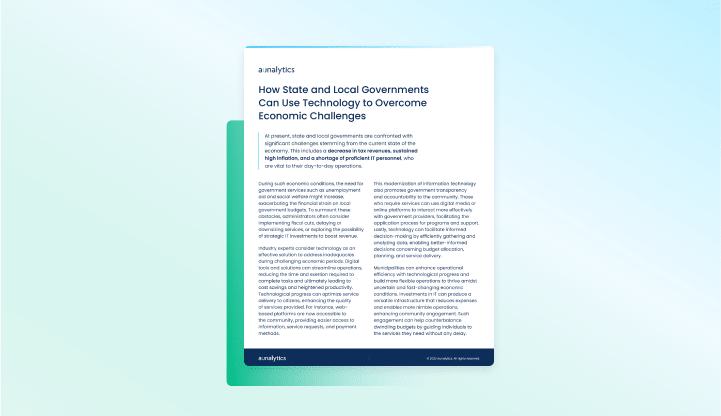
How State and Local Governments Can Use Technology to Overcome Economic Challenges
How State and Local Governments Can Use Technology to Overcome Economic Challenges
At present, state and local governments are confronted with significant challenges stemming from the current state of the economy. This includes a decrease in tax revenues, sustained high inflation, and a shortage of proficient IT personnel, who are vital to their day-to-day operations. Industry experts consider technology as an effective solution to address inadequacies during challenging economic periods.


Poor Document Sharing Strategies May Share Too Much Information with Bad Actors
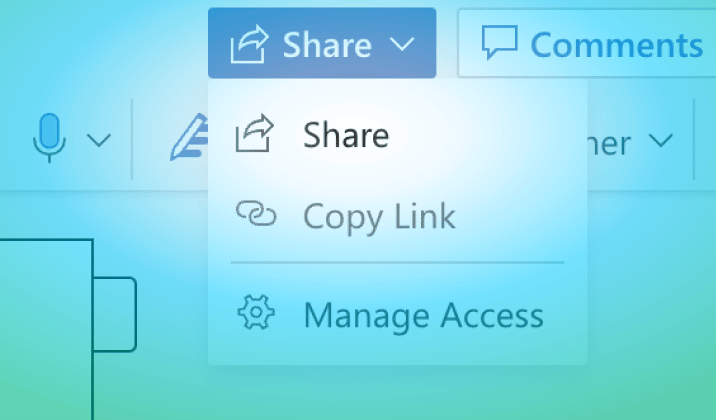
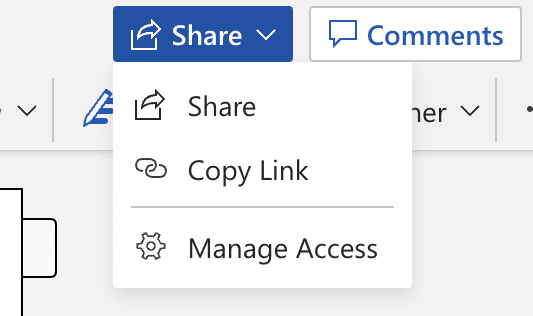
To share documents across your organization, it may be as easy as making a single click—but that doesn’t mean they are protected from malicious actors with bad intent. One mistake and you could be leaving holes in your security fabric, allowing hackers to access your company’s shared documents.
While file storing systems are a popular and useful solution, it can be dangerous to allow everyone in your company unimpeded access to everything they contain. Important company information, and many different files, live within document sharing applications—everything from job applications and budgets to employees’ personal information—which can make them a target for hackers. Document sharing applications can be risky if your company’s security and security training are not up to speed.
How can your organization ensure shared documents remain secure?
When looking to keep your document sharing application secure there are rules you and your employees should follow to ensure quality cyber security. A few of these rules include:
1. Use a password manager
A password manager can users track a multitude of passwords, allowing for a different, complex password for each work (or personal) login and account the user maintains. Utilize this idea to organize your passwords, maintain difficult to guess passwords, and keep track of each one in a secure digital location.
2. Enable multi-factor authentication
Multi-factor Authentication (MFA) requires you to perform a secondary action to finish logging into an account. MFA sends a message to a phone, or another device, providing you with a code that is needed to successfully log into your account. Without this code, anyone who has attained access to your email account cannot succeed in logging into your company’s network, even if they change your password and attempt to log in again.
3. Be choosy
Take the time to choose who can, should, and needs access to specific files and folders. If access is not essential to someone’s job, consider limiting their access to non-relevant portions of your document sharing solution. Removing access to HR or accounting files from someone who is in marketing may be a good choice to make. If someone needs a file from a location they do not have access to, many document sharing solutions allow you to create a link that expires after a certain amount of time. This link will only allow the receiver to view the file they need access to while they need access to it. After the link expires, the receiver will no longer be able to view the file.
4. Provide regular security awareness training
Regular cyber security awareness training sessions allow your employees to learn about new security concerns, kinds of attacks, and now to keep your organization safe from bad actors. Training employees to look for the signs of phishing, malware, ransomware, hackers, and security holes helps keep document sharing applications safe and secure.
When done right, document sharing is incredibly useful to every business, and can be done successfully by putting a little bit of extra effort into your cyber security planning. An experienced security partner can help keep your business safe from outside threats, allowing you peace of mind that your important files are secure and encrypted from bad actors.
Aunalytics, a secure managed services partner, can help you with everything from managing your IT services, to functioning as your SOC, and also provides advanced security services. With a focus on helping mid-market clients, Aunalytics works with you, step-by-step, to help you succeed your security goals.
Cloud or On-Prem Servers—Which Is Better for Your Company?
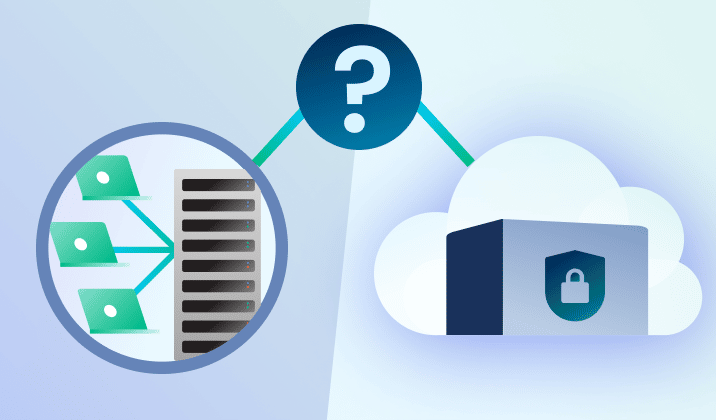
Every organization needs to manage its data to get its desired business outcomes. For a company to access its data and use it in day-to-day operations, dashboards, reporting, and data analytics, it either needs a cloud or on-premises solution to facilitate compute, storage, and data management strategies.
What’s The Difference Between The Cloud And On-Premises Data Storage?
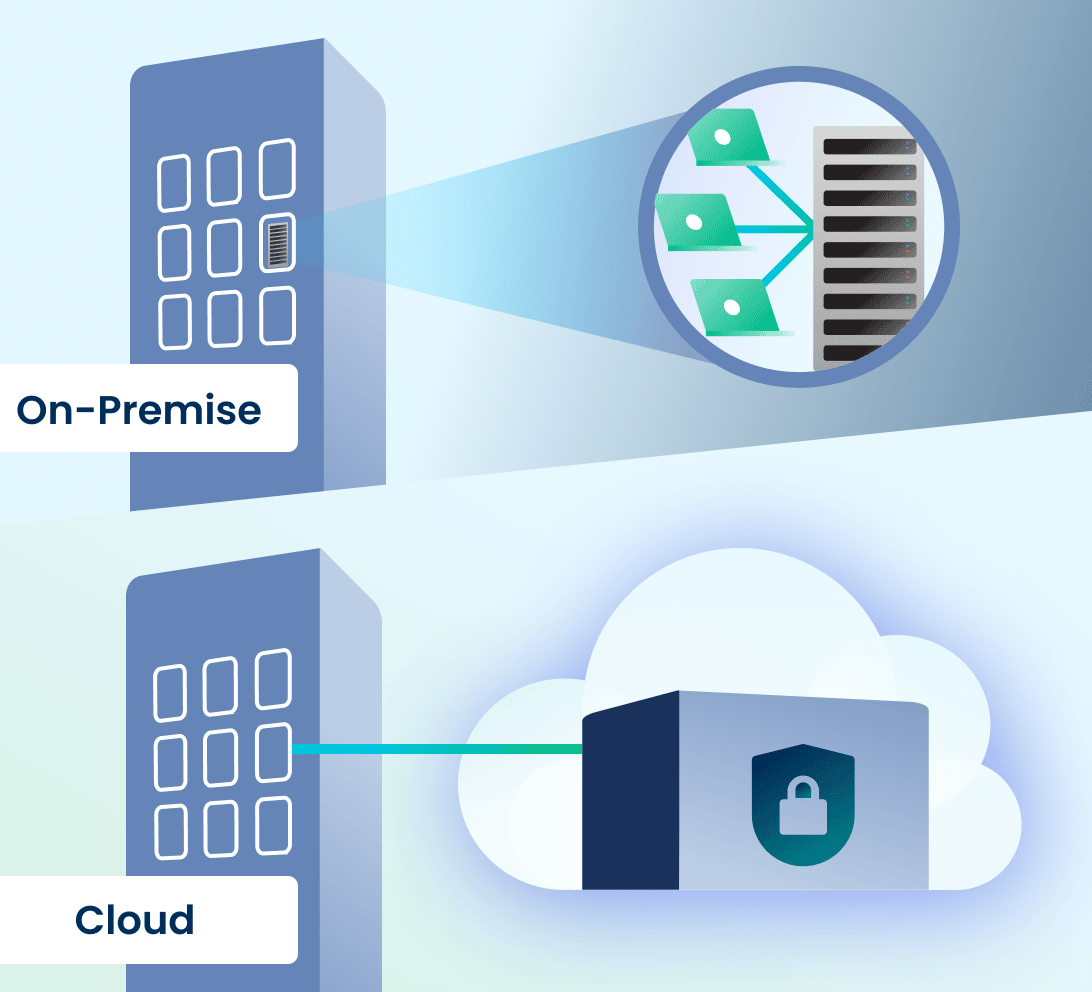
An on-premises data server is hardware that you maintain on your company’s premises for storing, processing, and accessing information through your organization’s networks. An in-house IT department is needed to maintain, turn over/replace, and upgrade the hardware, keep it stable and operational, and secure it.
A cloud storage solution run by an expert and backed by a cutting-edge data center provides the same functions as an on-premises server and more. It does not exist on your company’s premises and the data on it is accessed through the internet. All updates and maintenance tasks are performed by the cloud provider, who owns and operates its own hyper-secure data centers to safeguard your data in case of failure, cyberattack, or outage. Like on-premises servers, access to cloud data can be set by administrators to be permission-based to allow access only by authorized personnel.
On-Premises vs. Cloud—Which Option Best Suits Modern Business Needs?
There are more factors when choosing between using a cloud computing solution or keeping servers on-premises, including customizability and scalability, security concerns, and the budget for your organization’s data management strategy. While on-premises data servers regularly require hardware upgrades in your physical locations to expand alongside your business’s growing needs, a cloud storage and computing solution with access to highly advanced data centers is scalable based upon your workload. Unlike an on-premises server that can take a lot of time and money to set up and ready for operation, cloud service providers ensure you can access your cloud for computing and storage needs almost instantly.
In some mid-sized companies, server rooms tend to be used for multiple purposes, which means that they are sometimes unlocked, unsecured, and allow for unauthorized access that compromises data security. Many mid-sized companies do not have 24/7/365 monitoring of their server rooms, specialized climate controls needed for a data center, and do not consistently deploy or regularly schedule hardware upgrades to keep the systems reliable before something goes down.
One mid-market employee shares the story of a server closet that her company had in a previous workplace. For starters, it could be accessed by nearly every employee of the company. She recounted that the IT department placed portable dehumidifiers in the room to keep moisture down. The IT department’s regular practice was to empty the server closet dehumidifiers in the office’s kitchen sink. Unfortunately, a new IT employee happened to trip while carrying one of the dehumidifiers and spilled water all over the server room. Every employee of the company was affected—they found out that the work they had done since the last backup, which happened to be 5 days ago, had disappeared. Even worse, their servers were down for several days after the incident, further impacting their daily business operations.
Although in the past, people feared that cloud would not be secure, or a company would lose control over its data—cloud has proven to be more secure than on-premises hardware. First, cloud vendors host their own data centers and because this is their main business, they have cutting-edge climate control environments to protect their clients’ data. Cloud vendors adhere to frequent hardware replacement turn-over schedules to keep uptime maximized and cloud operations state-of-the-art. Cloud vendors monitor their data centers 24/7/365, are security experts, and have strict controls in place in order to service clients in highly regulated industries with rigorous data security needs. For most mid-sized businesses, it is more cost effective to rely upon the expertise of a cloud vendor for data security and uptime than to host and maintain its own servers, stay on top of the latest security threats, and staff its data center (or data closet) for monitoring to prevent downtime and security breaches.
Large enterprises often can afford to build their own data centers providing them an alternative to an external cloud provider. However, this is incredibly expensive and can set organizations back by USD $10-25 million on yearly setup and operation costs. This infrastructure also takes a lot of time to be implemented and in today’s fast-paced business environment, this might not be entirely acceptable for decision-makers.
Yet, even for enterprises, on-premises solutions no longer make the most sense. Most modern business applications are cloud-native. Cutting-edge data analytics solutions are cloud-native and connect and integrate data sources using cloud technologies. Clouds are better suited for analytics than on-premises hardware, due to scalability and ability to absorb compute spikes (instead of having to invest in hardware with capacity for compute spikes as machine learning algorithms converge—which leads to excess capacity at other times).
According to Insights for Professionals, 63% of senior IT leaders and company executives who were surveyed expected to invest in cloud infrastructure-as-a-service in 2022. Considering the state of on-premises servers, which are becoming an obsolete technology that require an IT department to keep a constant eye on it, cloud technology is a natural progression in infrastructure for better data management. Gartner reports by 2025 almost 85% of companies will have moved to a cloud-first approach. Cloud technology has now evolved to a point where it provides better stability and security at a more economical price than on-premises solutions.
Mid-Market Company Considerations
Many organizations are operating in hybrid and multi-cloud environments. This means that they have some data in on-site servers, some data in cloud based line of business applications (relying on the application provider for data storage in whichever cloud the application vendor uses for its product), and many have some data in a public cloud.
However, mid-market companies have added considerations when choosing a cloud solution. Most public cloud service providers do not offer data management services. You need to do this yourself. Yet, mid-market companies often do not have this expert talent in-house. For success, mid-market companies need a cloud hyper-scaler that also provides data engineering services to build data connectors and pipelines, warehouses, data lakes, and the like. This skill set is different from a typical IT employee. Hyper-scalers—who can help organizations with data management, transform data from disparate sources into a decision and analytics-ready status, and bring transactional data into the forefront using a cost-effective cloud solution—tend to be private cloud vendors. For this reason, private cloud solutions make more sense than public cloud for mid-sized organizations.

A side-by-side partnership with an experienced cloud-native data platform company will have a measurable and positive impact on mid-market company data management strategies, with built-in access to technical resources and experts, so that your company does not need to hire new FTEs to support data management. Rely on the data management companies for data management so that your company can focus on your main line of business.
Aunalytics’ high performance private cloud provides a highly redundant and scalable platform for hosting servers, data, analytics, and applications at any performance level. Aunalytics delivers data management in a side-by-side service model, bringing companies the technology and the talent needed for data management success. To learn more about our Enterprise Cloud solution, click here.

Bridging the Mid-Market Talent Gap for Digital Transformation
Bridging the Mid-Market Talent Gap for Digital Transformation
To achieve business value from data technology investments, mid-market companies need the right technical expertise and talent. Yet many mid-market firms push this onto their IT manager, assuming that since it is technology related, IT has it. This is a mistake because most IT departments do not have time for data analytics. They are busy full time keeping company systems stable and secure, and providing support to your team members. This by necessity results in IT deprioritizing data queries over crucial cybersecurity attack prevention. Business analysts and executives get frustrated waiting for data query results, and the data is stale or the business opportunity has passed by the time query results are in.

But even if your IT team had time for it, it still is a mistake to rely on traditional technology administrators for data analytics success. This is unless your IT department has expertise across a wide range of skill sets, from cloud architecture, database engineering, master data management, data quality, data profiling, and data cleansing. What’s more, your IT manager would need to have command over data integration, data ingestion, data preparation, data security, regulatory compliance, data science, and building pipelines of data ready for executive reporting from multiple cloud and on premises environments.
When you read this laundry list of needs, it becomes clear that most mid-market IT departments lack the specialized experts needed to derive business value from their data. Unlike larger enterprises that have the resources to hire skilled staff for these roles, the mid midsize organization requires another option that provides access to the right tools, resources, and support. One that integrates, enriches and is trained in utilizing AI, machine learning, and predictive analytics to achieve more useful results.

To read more, please fill out the form below:
Bridging the Mid-Market Talent Gap for Digital Transformation
Bridging the Mid-Market Talent Gap for Digital Transformation
To achieve business value from data technology investments, mid-market companies need the right technical expertise and talent. Yet many mid-market firms push this onto their IT manager, assuming that since it is technology related, IT has it. This is a mistake because most IT departments do not have time for data analytics. They are busy full time keeping company systems stable and secure, and providing support to your team members. This by necessity results in IT deprioritizing data queries over crucial cybersecurity attack prevention. Business analysts and executives get frustrated waiting for data query results, and the data is stale or the business opportunity has passed by the time query results are in.
But even if your IT team had time for it, it still is a mistake to rely on traditional technology administrators for data analytics success. This is unless your IT department has expertise across a wide range of skill sets, from cloud architecture, database engineering, master data management, data quality, data profiling, and data cleansing. What’s more, your IT manager would need to have command over data integration, data ingestion, data preparation, data security, regulatory compliance, data science, and building pipelines of data ready for executive reporting from multiple cloud and on premises environments.
When you read this laundry list of needs, it becomes clear that most mid-market IT departments lack the specialized experts needed to derive business value from their data. Unlike larger enterprises that have the resources to hire skilled staff for these roles, the midsize organization requires another option that provides access to the right tools, resources, and support. One that integrates, enriches and is trained in utilizing AI, machine learning, and predictive analytics to achieve more useful results.
Achieving Digital Transformation
Digital transformation has been defined by some as the integration of digital technology into all areas of a business, fundamentally changing how employees operate and deliver value to customers. Some of the challenges midsize businesses have with building an internal team to initiate this concept are employee pushback, lack of expertise to lead digitization initiatives, improper organizational structure, the absence of a digitization strategy and limited budget. As an alternative to building an internal operation, a more efficient way for mid-market businesses is to leverage the skillsets of experts by partnering with a consolidated group of experts, leveraging a side-by-side model that couples technology with talent. Look for solution providers that offer the following:
- Powerful cloud data centers paired with engineers skilled in architecting cloud-based applications and processes that better serve critical business requirements. These data centers are optimized for true multi-tenancy, built on seamlessly integrated hardware and software, offer business-driven configurability, world-class security and performant systems.
- Active Monitoring and Thoroughly Integrated Security. Monitoring and security should be pervasive across system infrastructure to defend against cyberattacks and provide remediation when required. Business customers will also expect full-time monitoring and on-demand help desk to address unexpected events. The data management platform underpinning applications should be monitored by experienced data engineers with success in building data warehouses, data lakes, and data pipes. They should also be able to integrate, cleanse, and transform data into decision-ready and analytics-ready business information.
- High ROI Business Insights that Drive Results. Data analytics investments need to provide real business value by giving actionable insights and finding opportunities within your data. With this in mind, data analytics should include access to data scientists and business analysts versed in your industry. These experts should be equipped to design AI-powered algorithms that answer the most pressing questions based on real-world business challenges.
Mid-Market Data Transformation for Enterprise-Class Results
Ensuring the right mix of hardware, software and resulting services are available to maximize the data center capabilities—and their ability to manage and protect data—is crucial to effective mid-market digital transformation. To compete and drive value, the cloud data center provider must deliver at all levels, with customizable business intelligence solutions powered by an effective data management platform that is secure and compliant. Successful mid-market digital transformation thus requires a shift of responsibilities for infrastructure procurement and maintenance to a third-party provider backed by experienced staff and best-in-class infrastructure.
When implementing a digital transformation project, your company gains from the many benefits this brings, such as a higher return on your IT investment, increased employee and customer experience, and greater business agility. This is further enhanced by leveraging experienced cloud engineers, data engineers, security experts, data scientists, and other highly skilled technical resources—achieving true business value from the investment. And by partnering with experts, your company’s time, resources, and innovation can be focused on its core competencies.

4 Questions Mid-market Companies Should Ask Themselves About Data Protection
4 Questions Mid-market Companies Should Ask Themselves About Data Protection
 When the working world went remote due to the COVID-19 pandemic, many never returned to the office. This created new data-security challenges for many businesses, with an increasing amount of sensitive data now being stowed in the cloud, and workers continuing to access company data from off-site locations.
How safe is cloud security, which now often relies on “zero trust” security principles based on a user’s location rather than user credentials? While some worry that cloud security is less reliable than on-premise security, that’s not actually the case, particularly for mid-market businesses. The fact is that your data is actually more secure in a remote data center managed by security experts than by your in-house IT team.
You may feel a false sense of security by having your IT department guard your servers in a closet — but this strategy is extremely risky when it comes to data protection. It’s not standard for mid-market IT departments to possess expert skills in cloud security and data security, which are needed to properly safeguard data. Many mid-market companies, particularly those not in highly regulated industries, do not currently have Security Operations Centers.
What’s more, it came to light at the end of 2021 that cyber-insurance renewals are becoming at times prohibitively expensive for all industries due to the exponential increase in cyber-attacks seen last year. The only way for mid-market companies in all industries to lower cyber-insurance premiums and ensure coverage is to implement enhanced data security measures.
Since data protection has become the most prevalent challenge in the cybersecurity market, it’s no surprise to see that according to Insights for Professionals, data protection is the main focus in 2022 for 85 percent of businesses surveyed; 37 percent plan to invest up to $500,000 on data protection in 2022, and 31 percent plan to invest more than $500,000 on data protection over the next 18 months. McKinsey also reports that 85 percent of midsize enterprises plan to boost their IT security spend until 2023.
All-Time High Cybercrime
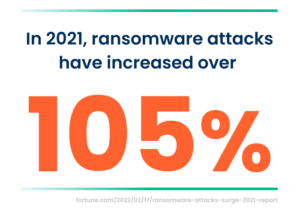 Still, it would be misleading to imply that cloud security comes with no challenges. One of the biggest ongoing concerns are ransomware attacks, which increased over 105 percent in 2021. Cybercriminals continue to attain new levels of sophistication, with payment demands skyrocketing into tens of millions of dollars. According to McKinsey, the costs related to cybercrime will continue to ascend in the coming years, with a 15 percent yearly increase leading to cybercrime costs reaching $10.5 trillion a year in 2025. Looking ahead over the next decade, by 2031, Cybersecurity Ventures estimates ransomware costs alone should reach $265 billion.
McKinsey reports that there are multiple motivations for these attacks, headed by the fact that pandemic-weary companies have become ripe for security vulnerabilities. Also, as advancing digitization continues to drive connectivity and employees now log in from anywhere — including unsecured home networks — it makes life easier for ransomware hackers. The traditional smash and grab approach is now being replaced with bad actors “dwelling” undetected within victims’ environments, which gives cybercriminals the lay of the land in understanding where the highest value information resides before selling it to the highest bidder.
Another motivation for the continued attacks is their success: as more companies are forced to pay ransoms, hackers are further incentivized to build on their well-paid victories and continue innovating on this lucrative threat. Specific sectors are particularly at risk; keep in mind that in the U.S., supply-chain attacks rose 42 percent in Q1 of 2021, victimizing as many as 7 million people, while McKinsey shared that “security threats against industrial control systems and operational technology more than tripled in 2020.” The war in Ukraine has taught us lessons about attacks compromising infrastructure, utilities and government that can debilitate nations and be weaponized.
Paying Up
These massive numbers can seem overwhelming, and can also make it difficult to tell how much a ransomware attack can affect an individual company. To give you some perspective, consider these stats:
- NPR reported that Colonial Pipeline paid a $4.4 million ransom after the company shut down operations.
- CNBC reported that global meat producer JBS paid ransomware hackers $11 million.
- Insider reported that global insurance provider CNA Financial forked over a reported mind-blowing $40 million post-cyber-attack.
- The Washington Post reported that a ransomware attack on U.S. software provider Kaseya targeted the firm’s remote-computer-management tool and endangered up to 2,000 companies globally.
These costs are also just the tip of the iceberg for the companies victimized by ransomware hackers. Additional costs of such an attack include everything from paying third parties (like legal, PR, and negotiation firms), not to mention the opportunity costs of having executives, staff, and teams disconnected from their day-to-day roles for weeks or months to deal with the attack’s aftermath. Perhaps the biggest unaccounted-for expense is the resulting lost revenue.
Ask These 4 Questions
What can mid-market companies do in the face of these threats to their data’s safety? They should focus on strategies that address ransomware prevention, preparation, response, and recovery. Since this is an ongoing journey, threats continue to evolve and improve — so it’s critical to keep up to date with new threats of increasing sophistication, while being ready with cybersecurity strategies and best practices. The goal is to continue to build cyber maturity that creates a resilient approach. You may not be able to stop attacks from occurring, but when they do, they won’t have the same impact if you’ve prepared in this way.
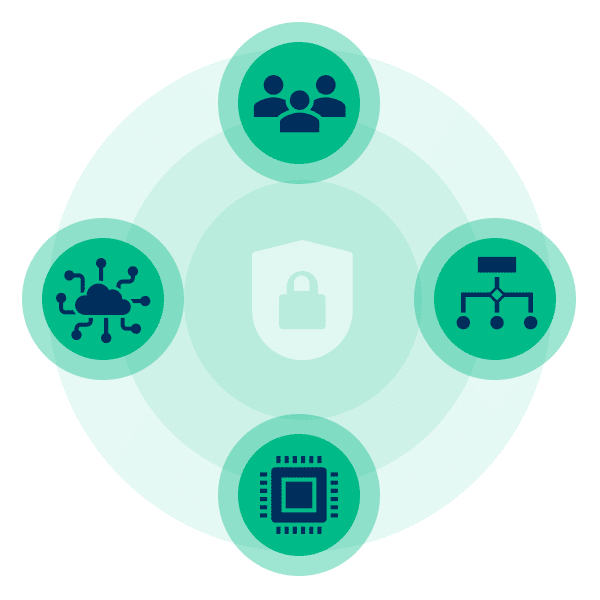
As a starting point, these are four questions that every mid-market company should ask itself to determine the organization’s readiness for data defense:
- When it comes to our people, do we have security focused IT leadership, trained cloud security experts, and data security experts?
- When it comes to our process, do we have defined IT security processes for proactively managing the security posture of our environments?
- When it comes to our technology, are we 100 percent confident in our security tech and our ability to actively monitor and detect threats around the clock?
- When it comes to our cloud architecture, are we confident that it allows for scalability without sacrificing security assurances?
If the answer is “no” or “I don’t know” to any of these questions, it is time to get your house in order — you are at risk. To stay alive, compete, and drive value, mid-market companies should shift their focus to data analytics, data management, security, and compliance. This requires a cloud-based data center, a cloud-native data management platform, and cloud-native analytics. Ensuring the right infrastructure to maximize the capabilities of data centers — and how they are able to manage and store data — is crucial to effective mid-market digital transformation.
The Key to Data-Driven Success for Mid-market Companies Starts Here
The Key to Data-Driven Success for Mid-Market Companies Starts Here
 What’s the #1 pain point for IT professionals? According to the business knowledge resource Insights for Professionals, it’s data center management. With this reality in mind, the foundation of digital transformation success for a data-driven business must begin at the data center level, where servers store your data, CPUs power your computations, and your systems are ideally kept stable, operational, and secure for all users, including those accessing company systems and data from multiple remote locations. Competitive mid-market companies rely on data center engineers who specialize in uptime by proactively preventing downtime, as well as connectivity, storage, security, and monitoring.
Effectively managing data to support accessibility and security requires consistent monitoring and up-to-date solutions. Yet the latest research shows that investing in on-premise infrastructure for data management, compliance, and analytics is too pricey for most mid-market companies — and from the view of many IT directors, on-premise solutions have already morphed into old relics. In 2022, Insights for Professionals reported that nearly two-thirds (63 percent) of senior IT leaders and company executives aren’t planning to attempt to maintain servers on-premise. Instead, the majority of leaders surveyed plan to invest in cloud infrastructure as a service.
Moving into the Future
 In short, entire businesses are migrating to the cloud, not just the technology. The infinite growth of data, applications, connections, and workloads will only further exacerbate businesses’ ability to adapt to new lines of business applications and platforms, meet security and governance requirements, and seamlessly orchestrate and analyze data for business outcomes. As a result, a growing number of mid-market companies are recognizing the value of working with partners to transition storage, computing, backup, and hosting services to cloud-based platforms to leverage the scale and compute power they can provide.
Gartner reports that by 2025, the vast majority — 85 percent — of enterprises will have already shifted over to a cloud-first approach. How did this changing of the guard occur so quickly? According to Gartner, it can be traced in part to the COVID-19 pandemic, which has accelerated cloud adoption since 2020, ushering it in as the “de facto new normal.” Gartner analysts including Gregor Petri even go so far as to state that “enterprise architecture and technology leaders should reject any new product that does not follow ‘cloud first’ as a guiding principle.”
Mid-Market Essentials
There are solid reasons behind mid-market businesses moving their data out of on-premise environments, particularly due to the efficiencies obtained from cloud-based business applications in multi-cloud and hybrid environments. This brings us back to data center vendors, who must then be ready to absorb the responsibility and cost of infrastructure capital expenses and maintenance — and it looks like many are already prepared to do so. In 2022 alone, nearly one-third (32 percent) of those surveyed by Insights for Professionals were planning to invest heavily in cloud management, to the tune of $500,000, while nearly 30 percent plan to spend even more. The largest part of this cloud management investment is being channeled toward security, with enterprises intending to spend 82 percent of this budget on data protection.
This is not a passing trend and is expected to have long-term consequences for purchase decisions in mid-market companies. By 2023, as scalability and cohesive cloud ecosystems join the ranks among the top three buying considerations for IT, Gartner anticipates that cloud architects will become key stakeholders when choosing tools for analytics and business intelligence. Here’s another surprising statistic to show the direction we’re heading in: while hyper-scale cloud providers (hyper-scalers) delivered and managed less than 1 percent of installed edge computing platforms in 2020, Gartner predicts this number to balloon to 20 percent by the end of 2023.
Different Needs for Mid-Market Players
There’s a catch, though, about hyper-scalers: most are not built for the mid-market. Therefore, mid-market companies won’t be able to reap the maximum benefit from the ability of traditional hyper-scale cloud providers to bring global business solutions, outsourcing, and consulting capabilities that can help other types of organizations migrate to, adopt, and build cloud-native offerings. It’s true that traditional hyper-scalers excel in leveraging the expertise of their cloud professionals to consult for platform re-architecture, application development, data migration, and transitioning services from technology stacks into macro- and microservices hosted in a data center on-premise, private cloud, public cloud (or any multi-cloud or hybrid combination thereof) — but not generally for mid-market companies.
Let’s drill down into some specific problems for mid-market players around hyper-scale cloud providers:
- It can be cost-prohibitive to obtain the level of help that most mid-market companies require, since most hyper-scalers are priced for large enterprises. Mid-market companies tend to need “white glove” services, which carry the highest price tag.
- Greater needs. Enterprises are more likely to already have in-house teams with the necessary skillsets to work with traditional hyper-scalers, compared to mid-market businesses that often have higher needs for expert help.
- No data analytics. While many enterprise hyper-scalers help migrate data to third-party cloud vendor platforms, their services end there, as they don’t offer data analytics.
Mid-market companies need technical experts to help build solutions on a mid-market budget — specifically, they require a hyper-scaler capable of providing an end-to-end solution focused on the mid-market sector. The goal in evaluating potential solutions providers should be for the cloud foundation to operate seamlessly with end-to-end data management and analytics solutions. With an end-to-end solution, mid-market businesses have the opportunity to obtain the results they desire without wasting time on a “Frankenstein” approach, assembling parts and pieces of multiple technologies and tools in an attempt to construct a reliable system that actually works. It’s only by going the end-to-end route that mid-market companies can receive the greater level of assistance they need on the technology front, as well as benefit from the robust data and analytics skillsets necessary to achieve meaningful business outcomes, without paying enterprise prices.

Ransomware Attacks Now Target Community Businesses
If you think that your business will not be a target for ransomware attackers, think again. This is no longer a problem only for large enterprises—now, ransomware attacks target community businesses as well.
The Battle Creek, Michigan community woke up to a May Day attack that forced its Kellogg Community College (KCC) to close all operations. In the middle of preparations for final exams, all five campuses serving approximately 6900 students closed and all operations came to a screaming halt.
The community college posted alerts on its website and social media:
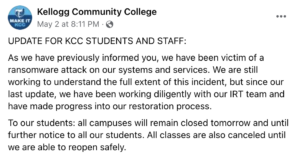
Eric Greene, the Vice President for Strategy, Relations, and Communications at KCC said: “We are still working to understand the full extent of this incident, but as soon as we became aware of it, we immediately assembled a multi-disciplinary team and engaged independent legal counsel and external forensic experts.”
Greene continued, “KCC had backups in place, and we are working systematically with our IT experts to restore our operations.” But even though KCC had backups, “As a precautionary measure, all campuses have been disconnected and our systems will remain offline until they are deemed secure by our IT experts. As a result, our students and staff might experience delays accessing our services, including campus emails, online classes, and resources,” Greene said.
Back-ups alone are not sufficient to prevent business disruption when a ransomware attack hits. Preventing the attack, rather than having to respond to it, is key. KCC remained closed for three days while IT scrambled. All computer access to university systems had to be shut down in an attempt to stop further damage. The response and mitigation included a forced password reset for all students, faculty and staff, and adding multi-factor authentication (MFA) for all users.
Enable Multi-factor Authentication
MFA is an important security measure when people access systems remotely. It provides an extra level of verification to make sure that the user attempting to access the system is really an authorized user and not a bad actor trying to get in. Modern business regularly includes employees logging in from home, travel and mobile devices to access data and systems from their organization. As such, the old firewall security perimeter around your place of business does not protect you. Modern security requires focus on users and access. MFA is something that is easy to add to your security stack. The protection benefit from MFA far outweighs the resource cost of installing and using the technology. Really, there is no excuse for not having MFA in today’s threat landscape. It is standard.
So if you do nothing else this year to improve your security posture, add MFA. But considering that community businesses are becoming targets for cybercrimes, unless you can afford a complete shut-down of your business, it is becoming a must to have modern security technologies (including robust monitoring so that you are equipped to prevent attacks and are better positioned to respond and mitigate), in addition to back-up and disaster recovery plans.
Shift Applications to the Cloud
Mid-market businesses are shifting security and data center responsibilities from on premise servers and security maintained by their IT department, to partnering with cloud experts who run data centers, keeping client systems stable and secure as their full time business. The trend with line of business applications used by your team for daily operations is cloud. As more and more community businesses use cloud based apps for functions like accounting, customer portals, ERP, CRM and HR, having cloud experts with the tools and the skills to be able to secure your organization’s data (from multiple sources) for safe use by remote users makes more sense than trying to build a security fortress yourself at your place of business.
Partner with Experts
If cybersecurity is not your main line of business, partner with security experts unless you want cybersecurity to become your main line of business. It will consume your resources to stay current with emerging threats, protective means, 24/7/365 monitoring, best practices and constantly evolving security measures. The ever increasing sophistication and volume of attacks has shifted the answer to the “buy it or build it” question for this critical business service from the solution being your in-house IT department to the solution requiring managed security services to supplement your in-house IT team.
Don’t become the next ransomware attack headline. Community businesses can take steps to avoid ransomware attacks. An ounce of prevention, after all, is less costly than the cost of operational shut-down, PR scramble, customer service disruption, brand reputation tarnishment, and emergency security consultant fees paid when you are in the middle of an attack that succeeded.