

The Truth About Artificial Intelligence in Business
Is the existence of Skynet imminent or is that simply a sci-fi trope? In this brief video, Dr. David Cieslak, Chief Data Scientist at Aunalytics, talks about the capabilities of Artificial Intelligence in business, some potential concerns with AI, and where the technology is headed in the future.
While there exists a broad range of applications for AI, in the business world, this technology has the potential to drastically change how we understand our customers and how we use our data to interact with them. Once created and trained with customer data, AI has the ability to quickly provide suggestions and insights that would otherwise be prohibitively difficult or even impossible to observe on your own.
David Cieslak, PhD, is the Chief Data Scientist at Aunalytics since its inception and leads its Innovation Lab in the development and delivery of complex algorithms designed to solve business problems in the manufacturing/supply chain, financial, healthcare, and media sectors. Prior to Aunalytics, Cieslak was on staff at the University of Notre Dame as part of the research faculty where he contributed on high value grants with both the federal government and Fortune 500 companies. He has published numerous articles in highly regarded journals, conferences, and workshops on the topics of Machine Learning, Data Mining, Knowledge Discovery, Artificial Intelligence, and Grid Computing.

A Data Scientist's Thoughts on Artificial Intelligence, Business, and the Future
A Data Scientist's Thoughts on Artificial Intelligence, Business, and the Future
In this interview, David Cieslak, PhD, the Chief Data Scientist at Aunalytics, describes complex analytics concepts such as artificial intelligence, machine learning, and deep learning, and explains how they are useful for businesses today—and will continue to be in the future. David has been with Aunalytics since its inception and leads its Innovation Lab in the development and delivery of complex algorithms designed to solve business problems in the manufacturing/supply chain, financial, healthcare, and media sectors.


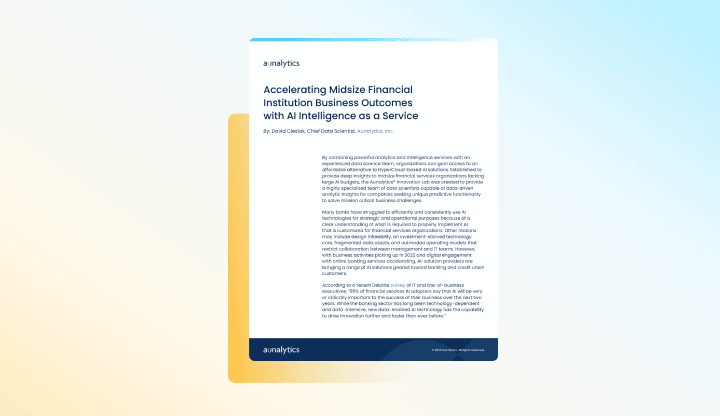
Accelerating Midsize Financial Institution Business Outcomes with AI Intelligence as a Service
Accelerating Midsize Financial Institution Business Outcomes with AI Intelligence as a Service
Many financial institutions have struggled to efficiently and consistently use AI technologies for strategic and operational purposes. To meet this need, the Aunalytics® Innovation Lab was established to provide deep insights to midsize financial services organizations lacking large AI budgets. This combination of powerful analytics and intelligence services with an experienced data science team allows organizations to gain access to an affordable alternative to HyperCloud-based AI solutions.
Related Content
Nothing found.
The Key to Data-Driven Success for Mid-market Companies Starts Here
The Key to Data-Driven Success for Mid-Market Companies Starts Here
 What’s the #1 pain point for IT professionals? According to the business knowledge resource Insights for Professionals, it’s data center management. With this reality in mind, the foundation of digital transformation success for a data-driven business must begin at the data center level, where servers store your data, CPUs power your computations, and your systems are ideally kept stable, operational, and secure for all users, including those accessing company systems and data from multiple remote locations. Competitive mid-market companies rely on data center engineers who specialize in uptime by proactively preventing downtime, as well as connectivity, storage, security, and monitoring.
Effectively managing data to support accessibility and security requires consistent monitoring and up-to-date solutions. Yet the latest research shows that investing in on-premise infrastructure for data management, compliance, and analytics is too pricey for most mid-market companies — and from the view of many IT directors, on-premise solutions have already morphed into old relics. In 2022, Insights for Professionals reported that nearly two-thirds (63 percent) of senior IT leaders and company executives aren’t planning to attempt to maintain servers on-premise. Instead, the majority of leaders surveyed plan to invest in cloud infrastructure as a service.
Moving into the Future
 In short, entire businesses are migrating to the cloud, not just the technology. The infinite growth of data, applications, connections, and workloads will only further exacerbate businesses’ ability to adapt to new lines of business applications and platforms, meet security and governance requirements, and seamlessly orchestrate and analyze data for business outcomes. As a result, a growing number of mid-market companies are recognizing the value of working with partners to transition storage, computing, backup, and hosting services to cloud-based platforms to leverage the scale and compute power they can provide.
Gartner reports that by 2025, the vast majority — 85 percent — of enterprises will have already shifted over to a cloud-first approach. How did this changing of the guard occur so quickly? According to Gartner, it can be traced in part to the COVID-19 pandemic, which has accelerated cloud adoption since 2020, ushering it in as the “de facto new normal.” Gartner analysts including Gregor Petri even go so far as to state that “enterprise architecture and technology leaders should reject any new product that does not follow ‘cloud first’ as a guiding principle.”
Mid-Market Essentials

There are solid reasons behind mid-market businesses moving their data out of on-premise environments, particularly due to the efficiencies obtained from cloud-based business applications in multi-cloud and hybrid environments. This brings us back to data center vendors, who must then be ready to absorb the responsibility and cost of infrastructure capital expenses and maintenance — and it looks like many are already prepared to do so. In 2022 alone, nearly one-third (32 percent) of those surveyed by Insights for Professionals were planning to invest heavily in cloud management, to the tune of $500,000, while nearly 30 percent plan to spend even more. The largest part of this cloud management investment is being channeled toward security, with enterprises intending to spend 82 percent of this budget on data protection.
This is not a passing trend and is expected to have long-term consequences for purchase decisions in mid-market companies. By 2023, as scalability and cohesive cloud ecosystems join the ranks among the top three buying considerations for IT, Gartner anticipates that cloud architects will become key stakeholders when choosing tools for analytics and business intelligence. Here’s another surprising statistic to show the direction we’re heading in: while hyper-scale cloud providers (hyper-scalers) delivered and managed less than 1 percent of installed edge computing platforms in 2020, Gartner predicts this number to balloon to 20 percent by the end of 2023.
Different Needs for Mid-Market Players
There’s a catch, though, about hyper-scalers: most are not built for the mid-market. Therefore, mid-market companies won’t be able to reap the maximum benefit from the ability of traditional hyper-scale cloud providers to bring global business solutions, outsourcing, and consulting capabilities that can help other types of organizations migrate to, adopt, and build cloud-native offerings. It’s true that traditional hyper-scalers excel in leveraging the expertise of their cloud professionals to consult for platform re-architecture, application development, data migration, and transitioning services from technology stacks into macro- and microservices hosted in a data center on-premise, private cloud, public cloud (or any multi-cloud or hybrid combination thereof) — but not generally for mid-market companies.
Let’s drill down into some specific problems for mid-market players around hyper-scale cloud providers:
- It can be cost-prohibitive to obtain the level of help that most mid-market companies require, since most hyper-scalers are priced for large enterprises. Mid-market companies tend to need “white glove” services, which carry the highest price tag.
- Greater needs. Enterprises are more likely to already have in-house teams with the necessary skillsets to work with traditional hyper-scalers, compared to mid-market businesses that often have higher needs for expert help.
- No data analytics. While many enterprise hyper-scalers help migrate data to third-party cloud vendor platforms, their services end there, as they don’t offer data analytics.
Mid-market companies need technical experts to help build solutions on a mid-market budget — specifically, they require a hyper-scaler capable of providing an end-to-end solution focused on the mid-market sector. The goal in evaluating potential solutions providers should be for the cloud foundation to operate seamlessly with end-to-end data management and analytics solutions. With an end-to-end solution, mid-market businesses have the opportunity to obtain the results they desire without wasting time on a “Frankenstein” approach, assembling parts and pieces of multiple technologies and tools in an attempt to construct a reliable system that actually works. It’s only by going the end-to-end route that mid-market companies can receive the greater level of assistance they need on the technology front, as well as benefit from the robust data and analytics skillsets necessary to achieve meaningful business outcomes, without paying enterprise prices.

Financial institutions are frequently targeted in cyberattacks—here’s how to protect your bank or credit union
 Financial institutions consistently have been the most cyberattacked industry for the past decade. It is no surprise, given that banking enterprises hold large volumes of sensitive data about people, companies, and governments, and their transactional business revolves around massive volumes of money transfer. Hackers will continue to strike with increasing sophistication since the data held by financial institutions is of high value with the potential for extremely lucrative financial gains if stolen. For example, the Europe-based Carbanak and Cobalt malware campaigns targeted more than 100 financial institutions in greater than 40 countries during five years from 2013-2018, and the criminal profits yielded over a billion Euros.
Attacks are increasingly sophisticated and cyber criminals continue to invest in new and complex criminal strategies and campaigns. Hackers in banking often take advantage of the interdependencies of financial institutions to service products such as credit cards and mortgages for other banks. From one bank breach, the cyber cartels jump to the partnered financial institution to steal its data as well.
In some types of cyberattacks, criminals make slight changes to data, which may not be immediately detectable. Because nothing is stolen at the time, users may not recognize the attack. However, once the criminals gain access to this data, they can manipulate algorithms in the system for their own financial gain. Timestamp manipulation is a newer strategy, whereby criminals have found that they are more likely to evade detection if they manipulate time for an otherwise valid transaction. Changing timestamps can alter the value of capital and trades. Because the parties to the transaction appear to be legitimate, this type of fraud is harder to detect.
Other criminals outright steal data for financial gain by selling it, hold data hostage for ransom profit, or pilfer intellectual property such as an organization’s competitive strategy and business plans to sell to interested parties. But the main goal in banking cyber-criminal activity is direct profit from a modern-day bank heist—stealing money from the bank.
Despite the increasing complexity of cyberattacks against financial institutions, there are some tools and best practices that banks and credit unions can use to protect themselves from these threats:
- Continuously update security technology and protocols as threats evolve and adapt with the help of a dedicated full-time security team.
- Employ 24/7/365 monitoring with remote remediation to quickly stop attacks in their tracks
- Monitor endpoint devices to stop attacks before they hit networks.
- Monitor cloud security including application use across the financial institution.
- Monitor email and Office 365 using tools specially designed to thwart attacks on these platforms, such as proactively recognizing and removing phishing scams.
- Have a dedicated security team and SOC, or hire an expert outside managed security services firm that embeds tools, technology and 24/7/365 monitoring to serve as your SOC.
- Push frequent patches so that user devices are equipped with the latest security protections.
- Adopt deep learning or AI monitoring, mitigation and context investigation that can more quickly identify threats.
- Encrypt data so that it is not compromised even if a breach occurs.
- Use multi-factor authentication to protect against unauthorized access.
- Instruct employees and customers to only access bank data in a secure location over a non-public Internet connection.
- Train employees on cybersecurity threats quarterly.
- Develop a solid business recovery plan for when an attack occurs.
Learn more about how Aunalytics Advanced Security helps protect financial institutions, and businesses in other highly regulated industries, from cyberattacks.

Marketing pitfalls can damage customer relationships—here's how to avoid them
While the main goal of marketing is to gain new customers or increase spend from existing customers, at times, marketing effort can do more harm than good. Unfortunately, a marketing campaign could not only fail to entice customers, but certain pitfalls could actively damage customer relationships. Fortunately, there are ways to avoid them. Below are three major mistakes that marketers are prone to making.
#1 Duplicate Mailers
 There is nothing more frustrating than opening up the mailbox and receiving multiple duplicate postcard mailers from a single company. Or when they are addressed to you using two variations or spellings of your name. Or when one is addressed to another member of your household and the second to you. Even worse, when one is addressed to you and another to a generic “household” at your address. Your household typically does not require more than one.
This leaves you to focus on the wasted paper and postage instead of the product or service being marketed. And if the company sending the mailer knew more about the target customer, perhaps the target is someone who does not respond well to snail mail and doesn’t like it. Mailed promotional materials go straight into the recycling bin without even entering houses in many households. This type of waste would be avoided by intel on channel preference of prospects.
When you receive duplicate mailings from a company that you do not do business with currently, it can be viewed as a sign that the customer experience would lack attention to detail, personalization and efficiency. This is a turnoff. That company is likely to be put on a mental list of those you do not want to do business with – period.
If a company that you are doing business with sends multiple duplicative mailers to your home, this can be even worse. In this digital world, many businesses ask customer profile questions including preferred contact method. If you opt in for electronic communications and e-bills, sending a mailer shows that the company is either not listening to its customers or the company is not communicating well within its internal teams. You took the time to complete the profile, yet the business can’t be bothered with using your input. Did anyone read your form fill results? Again, this shows lack of personalized customer experience, inefficiency and lack of cohesiveness in operations. As a current customer, you feel even more devalued than the business that does not have a relationship with you.
Sometimes the duplicate mailings are sent to your name using slight variations of your address, such as “Street” versus “St.” If the business cleaned up its mailing list and recognized that this is the same location, it would save on operational costs and make the company look smarter.
#2 Marketing Products to Customers Who Just Bought Them
A second frustration is receiving a mailer from a company that you currently do business with asking you to purchase products or services that you already have purchased from them. For example, a bank sends a mailer to open a HELOC account or a credit card account when you already have that product from that bank. Is the bank carpet bombing mailings to everyone? How wasteful. Is it that the bank does not care enough about you as a customer to take the time to realize which products you already have with them?
The misdirected marketing may cause customers to begin to think that they should place their business with a bank that cares about their business enough to know which accounts a customer has with them. Really, the relationship would be better if the bank stopped trying to engage its customers than continue to do so with communications that miss the mark.
#3 Bad Timing
A third pet peeve with marketing is when the offers are untimely. For example, if you just refinanced your mortgage with your bank, the bank should not send you a mailer 10 days later for a refinancing opportunity. Yes, customers appreciate notification of interest rates becoming more favorable. But given that you just paid closing costs (or folded them into your loan), refinancing 10 days later is not likely. Instead, you run the risk that the customer sees even better terms being offered and feels dissatisfied with his new product or even mad. From the customer’s perspective, if the bank had told him to wait 10 days, he’d have better terms. Marketing can do better on timing.
Marketing should not damage customer relations.
The Digital Data Challenge
Many businesses have a plethora of data that is typically siloed across many systems throughout the organization. Aggregating and integrating this data for marketing purposes is a major challenge that can be difficult and time-consuming, if not nearly impossible.
Hyper-personalized services that factor in intelligence about a customer holistically should form the core of customer relationships. To achieve this goal, businesses can integrate their disparate data architecture across lines of business and functions to create a 360-degree view of customers and allow for targeted marketing based upon data.
New and advanced data analytics powered by artificial intelligence (AI) are available today that enable customer intelligence to drive marketing. Aggregate your data and ensure that it is cleansed to remove duplicate customer lists for mailings. AI-powered analytics recognizes when people with different names are part of the same household to further eliminate duplicate mailings.
Harness the power of your data to personalize a customer’s experience with your company and not only avoid these pitfalls, but enable smarter targeted marketing.

Data Analytics Helps Midsize Financial Institutions Thrive
 The financial services industry continues to rapidly evolve. Between mergers, changing customer demographics, and increasing reliance on digital platforms for banking interactions, it can be difficult for smaller institutions to compete with large, national, and online-only banks in this crowded market. As customer interactions become increasingly digital, community and mid-market banks and credit unions are challenged with maintaining the competitive advantage that local, personalized, white-glove service has traditionally afforded them. This is why customer intelligence powered by data analytics helps midsize banks and credit unions thrive. However, they oftentimes struggle to achieve the valuable business insights that untapped data could provide to improve their operations.
It is unlikely that midsize and community banks will “out tech” large banks and fin-techs on their own. However, with the right partners, they have an opportunity to thrive by redefining the local experience and digitally transforming how they operate. Using the right data analytics, they can leverage their local knowledge with personalized customer intelligence to regain competitive advantage.
Customer Intelligence within Reach
Auna offers the ability to target, discover and offer the right services to the right people, at the right time. Built from the ground up for midsize community banks and credit unions, Auna is powered by the Intelligent Data Warehouse. The solution cleanses data for accuracy, ensures data governance across the organization, and employs AI and machine learning (ML) driven analytics to glean customer intelligence and insights from volumes of transactional data created in the business and updated daily. The daily insights and industry intelligence enable a variety of analytics solutions for fast, easy access to credible data, users can find the answers to such questions as:
- Which current customers that have a loan but not a deposit account?
- Who has a mortgage or wealth account with one of my competitors?
- Which customers with a credit score above 700 are most likely to open a HELOC?
- Which loans were modified from the previous day?
- Who are current members with a HELOC that are utilizing less than 25% of their line of credit?
Harnessing their data with Auna enables community banks and credit unions to discover patterns, insights, trends, and usage strategies helps to strengthen their position in regional markets and compete with large national banks. With Aunalytics, they are enabled to deliver timely personalized messages to customers, make data-driven product recommendations, measure campaign ROI, and grow net dollar retention.