

Use AI to Determine, Not Just Infer: Why Declarative AI Matters
Article
Use AI to Determine, Not Just Infer: Why Declarative AI Matters for Regulated Institutions
AI companies are racing to convince you that their models are smart enough to figure out your business. However, most enterprise AI deployments quietly fail in the gap between that promise and what regulated institutions actually need — a gap that declarative AI is built to close.
You’ve probably sat through a compelling AI demo. Their model answers fluently, summarizes documents, and generates reports that look like what your team spends hours producing by hand.
But then someone in the room asks whether it knows how you define a primary banking relationship. They ask whether it applies your credit policy thresholds the same way every time, and what you’d show a regulator who questioned a decision it made. Those are the questions that separate AI that looks good from AI that works for your institution, in your regulatory environment, at the stakes you’re operating under.
The Flaw in Model-Centric AI
A growing number of AI vendors are building what are called model-centric systems, on the premise that a sufficiently capable model given enough of your data will figure out your business. The models are genuinely impressive, but model intelligence isn’t what solves the problem these institutions face.
Every regulated institution — community bank, credit union, company running enterprise IT under compliance requirements — operates on institutional knowledge that is declared rather than discovered. Your definition of a criticized asset, your risk rating thresholds, and your rules for what triggers a relationship review aren’t patterns hidden in your data waiting for a model to find them. They are decisions your institution has made, codified in policy, and required to be applied consistently across every loan review, compliance filing, and customer interaction.
When a model-centric AI system tries to apply your institutional logic, it doesn’t read your policy manual and execute it. It infers what your logic probably is, based on patterns in your data and whatever context you’ve fed it at the moment of the query. Every answer is a probabilistic approximation of a declarative truth.
That level of approximation is acceptable for marketing copy, but not for a credit decision, a regulatory disclosure, or a risk report going to your board.
Declarative AI vs. Inferential: The Distinction That Changes Everything
There are two fundamentally different ways to make an AI system work:
Inferential AI asks the model to reason its way to the right answer using whatever data and context you provide, making the model itself the intelligence layer. In theory, a better model produces better output. In practice, the model’s output varies based on how a question is phrased, what context was retrieved, and what version of the model is running, so there is no single authoritative answer, only the current best inference.
Declarative AI encodes your institutional logic into the data foundation before the model ever sees it, expressing your definitions, rules, and thresholds as an explicit, governed data architecture. The model doesn’t need to infer what “aggregate calendar-year deposits” means, because your intelligence layer has already defined and computed it. The job of the model is to reason over a foundation of established fact rather than construct that foundation on the fly.
For companies in regulated industries, it’s the difference between an AI system you can stand behind and one you can only hope doesn’t embarrass you in front of an examiner.
Why "Better Models" Aren’t the Solution
The standard vendor response is that models are getting better fast, and soon they’ll handle institutional complexity reliably. Models are improving rapidly, but improvement doesn’t resolve the declarative vs. inferential problem. A more capable model makes better guesses; it doesn’t turn guesses into facts. Your credit policy isn’t a pattern to be discovered at higher confidence levels. It’s a decision to be applied with complete consistency.
Governance is the dimension that will eventually land on a CEO or CIO’s desk personally. SR 11-7 and similar guidance require your AI systems to be explainable and auditable, which means when an examiner asks why a decision was made, “the model reasoned its way to this answer” isn’t a defense — it’s an admission. A governed rule with documented provenance is something you can put in front of a regulator, a board risk committee, or your own general counsel. Model weights are not.
There’s also a cost structure dimension that matters more the longer you run the system. Model-centric AI is a variable cost that scales with usage: every query, every user, every new workflow adds to the bill, and the more your institution embraces AI, the faster the number grows. Platform-centric AI is closer to a fixed cost you build once, where the marginal cost of additional use is near zero. Per-token prices will keep falling, but they won’t close this gap, because the volume of tokens required to re-derive your institutional context at query time doesn’t compress. By year three, the two architectures produce very different numbers on your P&L.
The Integration Problem Nobody Talks About
There’s a harder truth underneath all of this that the AI demos never address: most enterprise AI deployments fail not because the model isn’t good enough, but because the data isn’t ready.
Your customer records live in one system, transaction history lives in another, and loan origination data lives in a third. None of those systems were designed to talk to each other, and none of them have consistent definitions of shared concepts. “Customer” means something different in your core banking platform, your CRM, and your treasury management system.
Getting an AI model to reason accurately over that environment isn’t a prompt engineering challenge; it’s a data engineering one. It is the part most AI programs systematically underestimate. Resolving customer identity across a core banking platform, a CRM, and a treasury system, reconciling how Fiserv or Jack Henry structures accounts against your own definitions, and maintaining those definitions through core upgrades and acquisitions requires years of domain-specific work. When an AI initiative stalls or comes in over budget, this is almost always where it happened.
This is the work most AI vendors skip. They show you what the model can do once someone else has solved the data problem. They leave the data problem to you.
The data foundation is the moat — not because it’s expensive to build, but because it takes years to do right and it’s specific to your institution. When a competitor promises to replicate it with a smarter model, they’re proposing to shortcut a decade of domain-specific engineering. That’s not a technical claim. It’s a sales claim.
Three Things to Require Before You Commit Budget
If you’re a CEO or CIO evaluating AI investments, there are three things worth requiring of any vendor before you commit budget.
Require that your institutional logic lives in the data layer, not in the model or the prompt. Your definitions and business rules should be explicit, governed, and independent of the model, so they survive vendor changes, model upgrades, and staff turnover. If a vendor can’t show you where that logic lives, you’re being asked to store your institution’s intelligence inside someone else’s product.
Require a clear model-upgrade path that doesn’t put your institutional knowledge at risk. In a model-centric architecture, a model upgrade can invalidate the logic encoded in the current model, forcing you to revalidate your AI every time the vendor ships a release. In a platform-centric one, the intelligence layer is model-independent and the model is a swappable component. Ask your vendor to explain their upgrade path.
Require that every AI-supported decision be defensible to a regulator on its own terms. You should be able to point to the rule itself — when it was authored, what data it depends on, what it produces — not a description of what the AI probably did. If a vendor can’t produce that, you’re the one who will be asked to explain it.
Before deploying any AI agent or generative capability into a regulated workflow, verify that the underlying data is trustworthy, governed, and AI-ready, with resolved customer identity, codified business definitions, and derived intelligence maintained as standing metrics rather than computed on demand. Build incrementally, but anchor the roadmap on what architecture serves your institution in year three, not what you can show in thirty days. And insist on model independence, so that as foundation models improve, you benefit from the improvement without having to revalidate your institutional logic.
The AI companies competing for your budget are offering real capability, and the models are improving, but model capability is increasingly a commodity. What isn’t a commodity is a declarative AI foundation — governed, institution-specific, and built to give every model you deploy established fact to reason from. That foundation is what separates AI that works in a boardroom presentation from AI that works at 8 AM on a Monday, when your banker needs to know who to call, why it matters, and what to say — and needs to be sure it’s right.


AI is Only As Good As Your Data
Article
AI is Only As Good As Your Data
Every week, another AI vendor promises their platform will transform your financial institution. Better member insights, smarter lending decisions, and automated reporting. The pitch is compelling and the pressure to act is real.
Before you sign a contract, there’s a question worth asking: Do you actually have the data to back it up?
AI is only as good as the data underneath it. And most financial institutions don’t have the data that’s ready for AI yet.
The key is starting with your data foundation first.
For financial institutions, the challenge isn’t the amount of data, it’s the data readiness. When you skip the step of cleaning and structuring your data and go straight to the AI layer, here’s what happens:
- The AI produces answers that feel authoritative but are statistically probable, rather than being declaratively accurate.
- You can’t audit the decision: you don’t know why it said what it said.
- You keep running the same calculations over and over, driving up costs with every query.
This isn’t a tech failure. It’s a sequencing failure. The intelligence has to be built into the data before you hand it to an AI.
What "AI-Ready Data" Actually Means
AI-ready data has been transformed, enriched with business logic, and structured so that when a question is asked, the answer is calculated, not guessed.
Think of it this way: if you ask an AI to tell you which members are at risk of leaving this quarter, it needs more than raw transaction records. It needs a unified view of each member’s relationship with your institution, behavioral signals over time, and the business rules your team uses to define “at risk” in the first place. That context must be built in.
The intelligence is in the platform. You must build it into the data layer before AI can deliver answers you can trust and act on.
Two Approaches and Why They're Not Equal
Approach One: Ask the AI to Figure It Out
Some vendors take raw data, often pulled from a cloud warehouse, and let the AI model do the calculations on the fly. The model ingests your data, runs its analysis, and returns an answer.
This sounds efficient. It’s not. Every calculation runs repeatedly, consuming tokens and compute resources with each query. Costs scale with usage, not with value. And when you ask, “why did you flag this member?” the answer is a statistical distribution, not a reason.
Approach Two: Pre-Compute the Intelligence
The more effective approach, and the one Aunalytics is grounded in, is to do the hard work before the AI ever sees the question. Every relevant metric, every business rule, every behavioral signal is calculated, validated, and stored in a structured intelligence layer.
When a question comes in, the AI retrieves a precise answer from data that was already prepared for it. The result is faster, cheaper, more accurate, and fully auditable.
This is what we mean when we say Aunalytics makes data AI-ready.
What This Means for Your Institution
If you’re a CEO, CIO, or CTO at a financial institution, this distinction matters for three reasons:
- Accuracy: Declarative answers built on prepared data are more reliable than probabilistic outputs from raw data. When a banker acts on an insight, they need to trust it.
- Auditability: Regulators and examiners want to know why a decision was made. With pre-computed intelligence, you can show your work. With probabilistic AI, you can’t.
- Cost: Paying for compute on every query — at scale — adds up fast. Pre-computed data means you’re paying for results, not repeated calculations.
The Partner Question
Most community financial institutions don’t have the data science teams, the infrastructure, or the time to build this foundation themselves. They don’t need to.
But they do need a partner who’s already done the work — one who understands community banking deeply and can deliver production-ready AI data as a service.
That’s not a software tool. It’s not a dashboard. It’s a managed service built on years of experience working with the specific data structures, core systems, and regulatory environment of community banks and credit unions.
Aunalytics has been building and refining banking-specific data sets for over eight years. The Intelligent Data Warehouse isn’t a general-purpose platform adapted for banking. It was built for banking from the ground up.
Before you evaluate the next AI platform, ask the vendor one question:
What does your solution do to prepare my data for AI before the AI ever touches it?
The answer will tell you everything.
Start With the Right Foundation
The institutions that will win with AI aren’t the ones who adopt it fastest. They’re the ones who build the right foundation first — and find a partner who can help them get there without building a data science department from scratch.
Citizens Federal Simplifies IT with Managed Services by Aunalytics
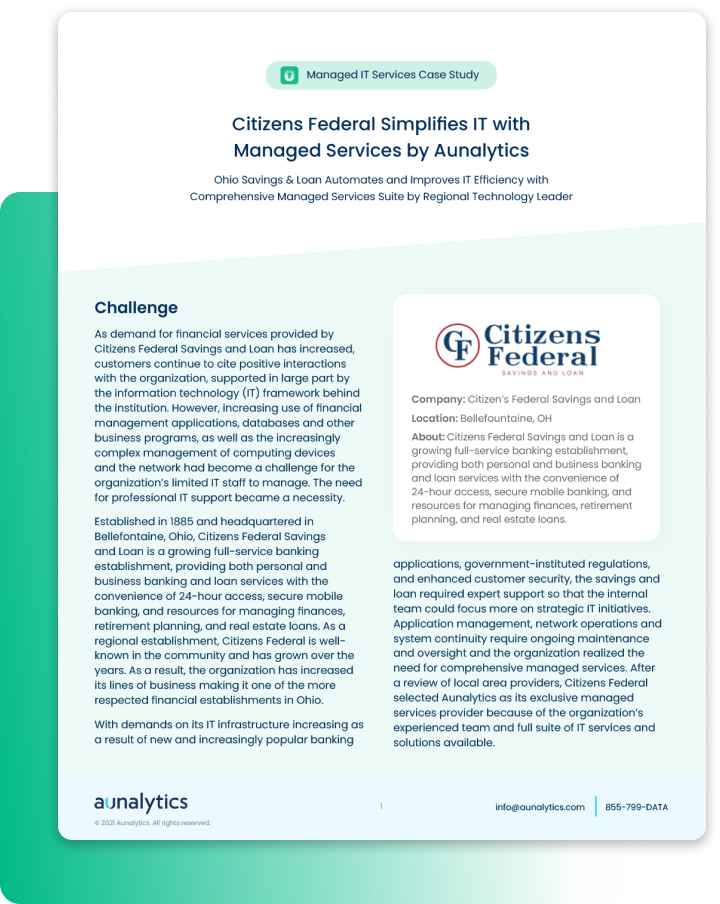
Citizens Federal Simplifies IT with Managed Services by Aunalytics
Ohio Savings & Loan Automates and Improves IT Efficiency with
Comprehensive Managed Services Suite by Regional Technology Leader
Fill out the form below to receive the case study.
Aunalytics is a data platform company. We deliver insights as a service to answer your most important IT and business questions.
Cybersecurity Controls Checklist
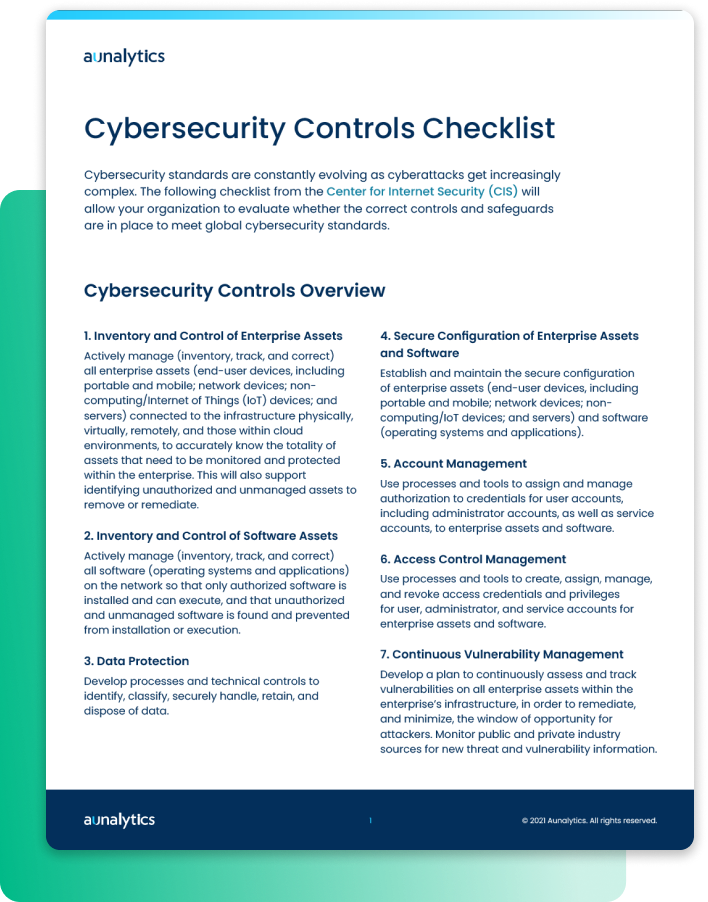
Cybersecurity Controls Checklist
Cybersecurity standards are constantly evolving as cyberattacks get increasingly complex. The following checklist from the Center for Internet Security (CIS) will allow your organization to evaluate whether the correct controls and safeguards are in place to meet global cybersecurity standards.
Fill out the form below to receive the article.
Aunalytics is a data platform company. We deliver insights as a service to answer your most important IT and business questions.
Managed Services is an IT Workforce Multiplier for Paulding Putnam Electric Cooperative (PPEC)
Managed Services is an IT Workforce Multiplier for Paulding Putnam Electric Cooperative (PPEC)
Aunalytics Brings Professional IT Infrastructure Services Team
to Support Operations Throughout Electric Utility
Fill out the form below to receive the case study.
Aunalytics is a data platform company. We deliver insights as a service to answer your most important IT and business questions.
Cybersecurity Drives Insurance Crack Down
Cybersecurity Drives Insurance Crack Down: Be Prepared to Document Your Security Posture
A common question for cyber insurance brokers in the last few years has been “If I implement this cyber security control, will I get a discount on my insurance premium?” The answer has been typically “no.” But these days, the answer has changed to “no, you won’t get a premium discount. And if you don’t implement that security control, you might not even get insurance.”
Fill out the form below to receive the article.
Aunalytics is a data platform company. We deliver insights as a service to answer your most important IT and business questions.

How Cybersecurity Mitigation Efforts Affect Insurance Premiums, and How to Keep Your Business Secure
 Cyberattacks have increased sharply over the past year. According to an August 2021 survey by IDC, more than one-third of organizations globally have experienced a ransomware attack or breach that blocked access to systems or data over the last twelve months. As a result, insurance companies are tightening eligibility requirements for cybersecurity coverage and requiring their insured to maintain higher standards of data security in order to qualify for better rates, and sometimes for renewal at all. Rates are increasing—up to 100%—for 2022, even for companies without any cyber incidents.
If you have received a renewal notice with a shocking sticker price for 2022, it is time to review your internal controls and security to learn if you can put in place further data protection to lower your rate. Worse, if you have received a notice that your business insurance policies are now excluding cyber coverage, data theft, or privacy breaches, you may be forced to shop for new cyber coverage at a time when attacks are at an all-time high. Without adequate security controls, obtaining coverage may be impossible. Due to the high cost of data breach incidents, you need to make sure that you are eligible for cyber coverage, but what does it take for 2022?
Aunalytics compliance and security experts are ready to help. We provide Advanced Security and Advanced Compliance managed services including auditing your practices, and helping you to mature your business cybersecurity processes, technology and safeguards to meet the latest standards and prevent new cyberattack threats as they emerge. Security maturity is a journey, and best practices have changed dramatically over the years. Threats evolve over time and so too must your cyber protection for your business to remain compliant and operational.
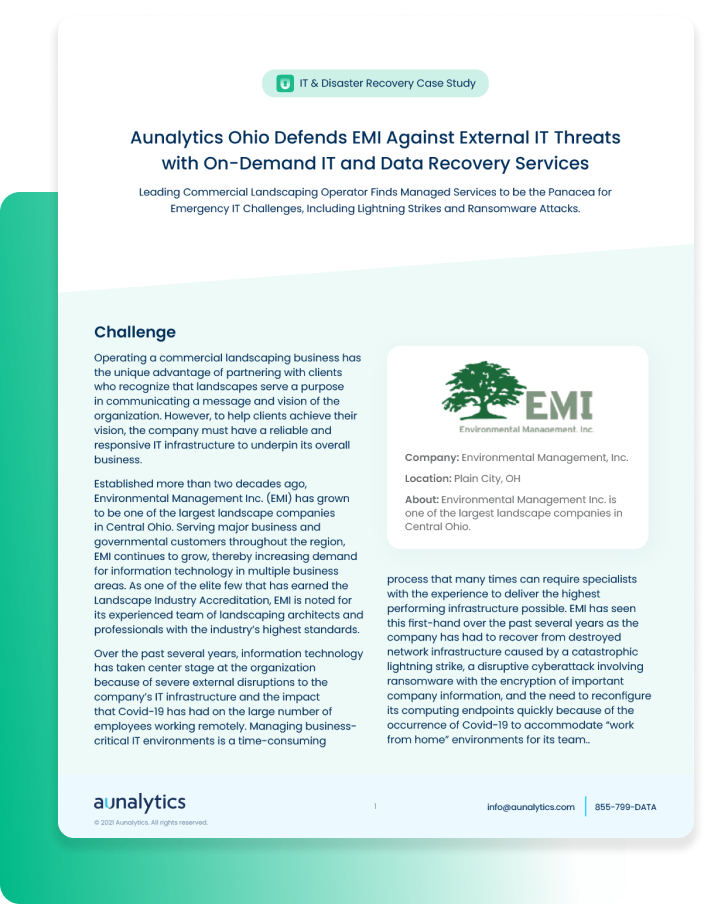
Aunalytics Ohio Defends EMI Against External IT Threats with On-Demand IT and Data Recovery Services
Aunalytics Ohio Defends EMI Against External IT Threats with On-Demand IT and Data Recovery Services
Leading Commercial Landscaping Operator Finds Managed Services to be the Panacea for Emergency IT Challenges, Including Lightning Strikes and Ransomware Attacks.
Fill out the form below to receive the case study.
Aunalytics is a data platform company. We deliver insights as a service to answer your most important IT and business questions.
Webinar: Do You Trust Your Data?
Do You Trust Your Data?
Presented by: Katie Horvath, CMO, Aunalytics
According to leading industry experts, 70% of digital transformation projects fail. Yet, companies successful with data-driven initiatives are realizing a 20-30% increase in customer satisfaction along with profit margins between 20-50%. So, what’s the secret to success?
In this session we will discover the keys to successful digital transformation and how to harness the power of your data to increase customer satisfaction and shareholder value.