


Unlocking the Value of Data Analytics: What Mid-Market Companies Need to Understand
Unlocking the Value of Data Analytics: What Mid-Market Companies Need to Understand
 Most mid-market companies make one mistake or another when investing in a data analytics platform, not understanding the many intricacies associated with preparing their data to get the best results. Some of the most common mistakes include:
- Not realizing they need to build pipelines to get the data from their multiple data sources to the analytics platform
- Tasking IT with implementing a data analytics solution, when the IT department does not have data science skillsets
- Basing analytics on data that is riddled with errors, incomplete, or stale, which compromises quality of decision-making due to the inaccuracy and tardiness of the underlying data.
- Relying on the reporting function of one data source and not taking into account data beyond that source for decision-making
- Using dashboards that provide insights into the past only, and not the future – a gap that needs to be bridged to compete with larger enterprises
It should also be noted that analytics requires massive storage and compute to mine data for actionable insights. Even in a cloud environment, which is less costly to maintain than on-premise servers, data analytics takes up a huge amount of compute to mine transactional data for AI-driven insights. Most data warehouses used by mid-market companies are not built for analytics, and their contracts with public cloud vendors for data storage often incur huge overage charges for compute spikes as millions of calculations are being completed for algorithms to converge for analytics results. Data analytics needs a cloud built for analytics. The mid-market should demand a built-in analytics cloud from an analytics solution, without a third-party public cloud contract to make it work (or attempt to host it in their regular institution data storage).
Industry Knowledge is Key
One of the most important aspects to understand is that there is no one-size-fits-all when it comes to data analytics. The value lies in industry specific data models, which must be built with algorithms using salient data points for a specific industry and appropriately weighted for that industry. For example, to build customer revenue in financial services, mining transactional banking data is important to reveal if a customer is doing business with competing financial institutions so that action can be taken to win this business over. In manufacturing, comparing product inventory at various channels and channel or retail sales locations is important for discerning sales performance and growth opportunities. In healthcare, mining insurance reimbursement claims for underpayments to recapture lost revenue requires comparisons of contracted amounts and fee schedules for multiple private insurance companies, plan coverages, and more. The true business value of analytics lies in industry specific data models and the data enrichment made possible by deep learning and the generation of actionable insights.
The Importance of Having the Right Expertise
This brings us to the requirement for data scientists and business analysts, which assist with achieving powerful and current actionable insights that lead to AI-driven decision-making and better business outcomes. Data scientists build algorithms to detect trends, patterns and predictions based upon the data, to position an enterprise for the future. Business analysts are industry specific and connect the dots between the data points relevant for answering business questions in that particular industry. They also help to design dashboards and other data visualizations to ensure that the insights generated answer questions important to that industry using industry-specific terminology, and analyze analytics results in the context of industry knowledge to reveal growth drivers and other opportunities for driving revenue. Typical IT departments do not have these skill sets.
Data Analytics Platform Requirements
Consider these questions when evaluating a data analytics platform:
- Which data sources are forming the basis for the insights: Is the analysis based upon only some of the data, leaving out important data sources? Do the analytics use the most important data points? Is too much data or the wrong data being used?
- How is the data cleansed for accuracy: To judge the accuracy of the insights, know what is being done to eliminate errors in the underlying data being analyzed. Garbage in leads to exponential garbage out when data is turned over to AI. Can the data be trusted?
- Which algorithms are being used to find insights: Is it a specialized or generic deep learning model? Is it optimized for the type of inquiry or result being sought? Is it tailored to a specific industry and weighted appropriately for that industry and the question posed? Can the results be trusted?
- Are the analytics results providing actionable insights such as how to grow revenue, improve efficiency or achieve other business outcomes? Are the results tied to solving business challenges, and not just AI for the sake of being cool?
Side-by-Side Approach
 Most mid-market companies are not in the business of IT or data science. IT is a necessary administrative function for operating a business, but should not become the main focus of most non-tech mid-market companies. However, given the expertise needed to use and maintain most analytics solutions, and the cost of data expert professionals as FTEs, the cost of data management and analytics can quickly overtake mainline business COGS expenses. Given all the complexities and challenges associated with unlocking the true value of data analytics, a new approach is needed that mid-market businesses can afford, enabling them to leverage AI-driven analytics and more effectively compete.
A side-by-side service model offers an alternative that goes beyond most tools and platforms on the market by providing a data platform with built-in data management and analytics, as well as access to human intelligence in data engineering, machine learning, and business analytics. Ideally it should operate as a cloud-based platform with a subscription service that places the burden of the data engineering expertise, technical tooling, and building and maintaining the infrastructure on the data management provider.
While many companies offer tools, and many consulting firms can provide guidance in choosing and implementing the tools, integration of all the tools and expertise in one end-to-end solution built for non-technical business users is key for digital transformation success for midmarket businesses.




Mid-Market Companies: Here’s How to Manage Your Data for the Best Business Outcomes
Mid-Market Companies: Here’s How to Manage Your Data for the Best Business Outcomes
 To make data usable, you need data management. While some think of data management simply moving your data into a cloud or a data lake, it’s much more than this. True data management should focus on making data informative by correlating and integrating data from multiple disparate sources and systems across your organization, adding third-party sources and transactional data created in daily operations.
Data management should also include:
- Cleansing the data to reduce errors
- Normalizing it so that aggregated information may be used for reporting, analytics, and better decision-making
- Governance for compliance with regulated industry and data privacy laws, and to ensure authorized access
- An audit trail of changes made to the data and which systems are using it
Cost Concerns
It’s a big job, so it’s no surprise that enterprise-sized companies often have a financial advantage over the mid-market when it comes to data management. That’s because while enterprises likely have in-house teams with the necessary data management skillsets, it’s cost-prohibitive for most mid-market companies to invest in the technical talent needed for data engineering and management. Most mid-market companies do not have the data engineering expertise needed to use data management tools and technologies within their in-house IT team, or their IT team is too busy vigilantly keeping systems stable and secure—which should be IT’s primary and full-time focus.
Nearly half of IT professionals believe that data management is a significant barrier to digital transformation because digital processes and technologies such as the cloud are rapidly evolving and increasingly sophisticated. McKinsey & Company points out that the COVID-19 pandemic significantly accelerated these trends. This means successful data integration and management requires advanced data experts whose job is to stay current on quickly evolving data management technologies, which can be challenging for the mid-market to acquire. And even if you can find this talent, it often does not make financial sense for the mid-market to hire FTEs to obtain the skillsets needed for success.
Heavy Investment
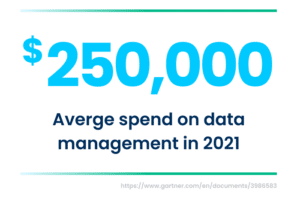 Nevertheless, finding an effective way to integrate data management is non-negotiable for organizations of any size. Our modern way of doing business includes multiple decentralized data sources and applications, often chosen by separate business units for what works best in their daily operations. This means that in order to get a complete picture of your business, data from multiple cloud sources, on premise sources and third party sources needs to be integrated to keep corporate information consistent across the organization and ensure that decision-making is based on an accurate complete picture of the business. Insights for Professionals found that in 2022, 62 percent of senior IT leaders and company executives surveyed plan to invest in data management, with three-quarters honing in on digital technology and data integration. Gartner reported that in 2021, each company’s average spend on data management tools was close to $250,000. Insights for Professionals results show that in 2022, 30% of IT experts intend to invest up to $500,000 on data management, with around one-quarter planning to spend even more.
Looking ahead to 2024, Gartner also reports that cloud-native platforms will serve as the foundation for more than 75 percent of new digital workloads. This statistic is particularly meaningful for mid-market companies, where end-to-end solutions become a lifeline to leverage cloud technology efficiencies and advancements without the need for hiring in-house expert skill sets. The right end-to-end solution for the mid-market pairs the right combination of tools and technologies with access to the expert talent needed to achieve value and success. The right end to end solution includes everything so that mid-market companies need not spend years trying to piece together a solution out of countless possible tools and technologies. Building it just takes too much time and resources away from the primary business of most mid-market companies—and the mid-market does not have time to wait for this and thrive against competitive pressure from large enterprises.
By 2024, Gartner predicts that three quarters of organizations will have deployed multiple data hubs to drive data and analytics, since companies should only make decisions based on a complete picture of their data. But for mid-market companies with affordability concerns, few solutions meet the need for data management technology that enables companywide data integration as well as third-party data.
Solutions for the Mid-Market
 Since mid-market firms that want to stay competitive can’t afford to fall behind enterprise-sized companies when it comes to data management, what can they do? Mid-market companies need technical experts to help build solutions, and research shows these solutions will be cloud-based. Insights for Professionals found that in 2022, close to two-thirds (63 percent) of senior IT leaders and company executives surveyed expect to invest in cloud infrastructure as a service. It makes sense over trying to maintain servers on-premise, recognizing that on-premise solutions have morphed into dinosaurs. According to Gartner, 85 percent of companies will have moved to a cloud-first approach by 2025.
Yet most hyper-scaler cloud service providers are priced for large enterprises, particularly to get the level of help that mid-market companies require. What’s more, many enterprise hyperscalers don’t offer data management, since their services focus only on migrating data to third-party cloud vendor platforms. Mid-market businesses need a hyperscaler capable of providing data management within a mid-market budget.
To ensure that important business decisions are not made based on inaccurate information, the mid-market needs an affordable data-cleansing solution.
Ideally, this means that data management would transform the data into decision-ready, analytics-ready status, including transactional data that sheds light on operations and customer behaviors. Gartner predicts that through 2024, half of organizations will adopt modern data quality solutions to better support digital business initiatives. To keep from falling behind, the mid-market must follow suit.
The Key to Consistency
In order to keep data consistent across the organization, another solution for the mid-market is to adopt master data management (MDM). MDM helps to ensure that if a customer’s contact information is updated through customer support, for example, then accounting and all other functional business units will receive the updated information. If data is kept in multiple siloes, operational efficiency decreases as employees spend time trying to track down data for reporting, analyzing, and determining which details are correct.
MDM technology has traditionally only been accessible to large enterprises due to its high cost, as most MDM platforms are a huge expense and implementation takes more than a year to achieve. These platforms typically also require highly skilled FTEs to use and maintain, which can be another cost consideration that rules out mid-market companies.
The answer to successful mid-market data management is to establish a side-by-side partnership with a data platform company to gain the benefits of working with experts and gain access to highly skilled technical resources to achieve true business value. By getting this help, you can devote your company’s time, resources, and innovation to your business and focus on what you do best.