

The AI Compute Constraint and the Case for an Intelligence Layer
Article
The AI Compute Constraint and the Case for an Intelligence Layer
On May 6, Anthropic announced a new compute partnership with SpaceX. Buried in the announcement was a number that should reframe how every CIO in a regulated industry plans their 2026 AI roadmap: Anthropic is projecting roughly 80x demand growth in Q1 2026.
If that number holds, the race has shifted to compute, infrastructure, and orchestration capacity. The winners will be the enterprises that build an Intelligence Layer: the discipline and architecture to know when not to use frontier models.
For the last couple of years, enterprise AI strategy has had a simple shape: pick a frontier model, point your workflows at it, and let intelligence flow. That worked when usage was experimental, costs were absorbed in innovation budgets, and compliance teams hadn’t yet asked the hard questions. It doesn’t work at the scale we’re now entering.
Three forces are converging on enterprise AI:
Frontier capacity is constrained, and the constraint is physical.
Anthropic's deals with SpaceX, Amazon, Google, Microsoft, and NVIDIA are a signal. The frontier labs themselves are telling us the binding constraint has moved from capability to capacity.
Frontier models are economically inappropriate for most enterprise tasks.
A regulated bank doesn't need a trillion-parameter reasoning model to classify a transaction or route a service ticket. Sending those tasks to a frontier endpoint is the equivalent of dispatching a corporate jet to pick up the mail. It works. But it also burns capital that should be funding actual differentiation.
Regulated industries can't tolerate opaque dependencies on a single model path.
When every workflow is wired directly to a frontier API, you inherit that vendor's outages, rate limits, data residency posture, and pricing changes, with no control plane to absorb the shock. For a CIO at a regulated institution, that arrangement belongs on a risk register, not an architecture diagram.
The architectural conclusion: an Intelligence Layer
The strategic message is clear: frontier intelligence is becoming too expensive and too scarce to sit in the direct execution path for every request. Enterprises that recognize this are moving toward an architecture where frontier models are a selectively-invoked resource rather than the default destination for every request.
We call this an Intelligence Layer, and it sits between your business systems and the model landscape. It does five things:
- Routes each request to the right tier of intelligence (frontier, specialized, classical ML, or a deterministic rule);
- Governs policy, data residency, masking, and audit at the routing point before any data leaves your environment;
- Contextualizes the right enterprise data into the right prompt without leaking the rest of the warehouse;
- Orchestrates multi-step agent workflows so a single business task doesn’t become a hundred opaque API calls; and
- Observes every decision, model call, cost, and latency, turning AI from a black-box expense into a measurable operational system.
Framed plainly, the Intelligence Layer is the economic control plane for enterprise AI. It’s what allows a CIO to answer the questions a board is starting to ask: What did AI cost us this quarter? Which workloads drove the cost? Which of those workloads needed a frontier model? Are we compliant? Are we resilient if our top vendor has an outage tomorrow?
The opportunity hiding inside the constraint
Here’s the part that gets missed in the headlines about GPU shortages and gigawatt deals: scarcity is clarifying. It forces enterprises to ask a question they should have been asking all along, “What is the right intelligence for this task?” instead of defaulting to the most intelligence for every task.
Banks that get this right will see lower AI run-rates, faster compliance reviews, and better outcomes from the workflows that genuinely need frontier reasoning, because those calls will no longer be competing with thousands of trivial requests for the same capacity.
IT leaders who get this right will have something they can defend in front of a board, a regulator, and an auditor: a documented, observable, governed system for deploying AI — not a collection of integrations stitched into production.
The compute race that Anthropic’s announcement signals is real, and it will reshape the economics of this industry. But for the CIO of a regulated enterprise, the strategic question is less about how much frontier capacity you can secure and more about how much of your business genuinely needs it, along with how disciplined you are about routing the rest.
That discipline is the moat, and the Intelligence Layer is how you build it.


Use AI to Determine, Not Just Infer: Why Declarative AI Matters
Article
Use AI to Determine, Not Just Infer: Why Declarative AI Matters for Regulated Institutions
AI companies are racing to convince you that their models are smart enough to figure out your business. However, most enterprise AI deployments quietly fail in the gap between that promise and what regulated institutions actually need — a gap that declarative AI is built to close.
You’ve probably sat through a compelling AI demo. Their model answers fluently, summarizes documents, and generates reports that look like what your team spends hours producing by hand.
But then someone in the room asks whether it knows how you define a primary banking relationship. They ask whether it applies your credit policy thresholds the same way every time, and what you’d show a regulator who questioned a decision it made. Those are the questions that separate AI that looks good from AI that works for your institution, in your regulatory environment, at the stakes you’re operating under.
The Flaw in Model-Centric AI
A growing number of AI vendors are building what are called model-centric systems, on the premise that a sufficiently capable model given enough of your data will figure out your business. The models are genuinely impressive, but model intelligence isn’t what solves the problem these institutions face.
Every regulated institution — community bank, credit union, company running enterprise IT under compliance requirements — operates on institutional knowledge that is declared rather than discovered. Your definition of a criticized asset, your risk rating thresholds, and your rules for what triggers a relationship review aren’t patterns hidden in your data waiting for a model to find them. They are decisions your institution has made, codified in policy, and required to be applied consistently across every loan review, compliance filing, and customer interaction.
When a model-centric AI system tries to apply your institutional logic, it doesn’t read your policy manual and execute it. It infers what your logic probably is, based on patterns in your data and whatever context you’ve fed it at the moment of the query. Every answer is a probabilistic approximation of a declarative truth.
That level of approximation is acceptable for marketing copy, but not for a credit decision, a regulatory disclosure, or a risk report going to your board.
Declarative AI vs. Inferential: The Distinction That Changes Everything
There are two fundamentally different ways to make an AI system work:
Inferential AI asks the model to reason its way to the right answer using whatever data and context you provide, making the model itself the intelligence layer. In theory, a better model produces better output. In practice, the model’s output varies based on how a question is phrased, what context was retrieved, and what version of the model is running, so there is no single authoritative answer, only the current best inference.
Declarative AI encodes your institutional logic into the data foundation before the model ever sees it, expressing your definitions, rules, and thresholds as an explicit, governed data architecture. The model doesn’t need to infer what “aggregate calendar-year deposits” means, because your intelligence layer has already defined and computed it. The job of the model is to reason over a foundation of established fact rather than construct that foundation on the fly.
For companies in regulated industries, it’s the difference between an AI system you can stand behind and one you can only hope doesn’t embarrass you in front of an examiner.
Why "Better Models" Aren’t the Solution
The standard vendor response is that models are getting better fast, and soon they’ll handle institutional complexity reliably. Models are improving rapidly, but improvement doesn’t resolve the declarative vs. inferential problem. A more capable model makes better guesses; it doesn’t turn guesses into facts. Your credit policy isn’t a pattern to be discovered at higher confidence levels. It’s a decision to be applied with complete consistency.
Governance is the dimension that will eventually land on a CEO or CIO’s desk personally. SR 11-7 and similar guidance require your AI systems to be explainable and auditable, which means when an examiner asks why a decision was made, “the model reasoned its way to this answer” isn’t a defense — it’s an admission. A governed rule with documented provenance is something you can put in front of a regulator, a board risk committee, or your own general counsel. Model weights are not.
There’s also a cost structure dimension that matters more the longer you run the system. Model-centric AI is a variable cost that scales with usage: every query, every user, every new workflow adds to the bill, and the more your institution embraces AI, the faster the number grows. Platform-centric AI is closer to a fixed cost you build once, where the marginal cost of additional use is near zero. Per-token prices will keep falling, but they won’t close this gap, because the volume of tokens required to re-derive your institutional context at query time doesn’t compress. By year three, the two architectures produce very different numbers on your P&L.
The Integration Problem Nobody Talks About
There’s a harder truth underneath all of this that the AI demos never address: most enterprise AI deployments fail not because the model isn’t good enough, but because the data isn’t ready.
Your customer records live in one system, transaction history lives in another, and loan origination data lives in a third. None of those systems were designed to talk to each other, and none of them have consistent definitions of shared concepts. “Customer” means something different in your core banking platform, your CRM, and your treasury management system.
Getting an AI model to reason accurately over that environment isn’t a prompt engineering challenge; it’s a data engineering one. It is the part most AI programs systematically underestimate. Resolving customer identity across a core banking platform, a CRM, and a treasury system, reconciling how Fiserv or Jack Henry structures accounts against your own definitions, and maintaining those definitions through core upgrades and acquisitions requires years of domain-specific work. When an AI initiative stalls or comes in over budget, this is almost always where it happened.
This is the work most AI vendors skip. They show you what the model can do once someone else has solved the data problem. They leave the data problem to you.
The data foundation is the moat — not because it’s expensive to build, but because it takes years to do right and it’s specific to your institution. When a competitor promises to replicate it with a smarter model, they’re proposing to shortcut a decade of domain-specific engineering. That’s not a technical claim. It’s a sales claim.
Three Things to Require Before You Commit Budget
If you’re a CEO or CIO evaluating AI investments, there are three things worth requiring of any vendor before you commit budget.
Require that your institutional logic lives in the data layer, not in the model or the prompt. Your definitions and business rules should be explicit, governed, and independent of the model, so they survive vendor changes, model upgrades, and staff turnover. If a vendor can’t show you where that logic lives, you’re being asked to store your institution’s intelligence inside someone else’s product.
Require a clear model-upgrade path that doesn’t put your institutional knowledge at risk. In a model-centric architecture, a model upgrade can invalidate the logic encoded in the current model, forcing you to revalidate your AI every time the vendor ships a release. In a platform-centric one, the intelligence layer is model-independent and the model is a swappable component. Ask your vendor to explain their upgrade path.
Require that every AI-supported decision be defensible to a regulator on its own terms. You should be able to point to the rule itself — when it was authored, what data it depends on, what it produces — not a description of what the AI probably did. If a vendor can’t produce that, you’re the one who will be asked to explain it.
Before deploying any AI agent or generative capability into a regulated workflow, verify that the underlying data is trustworthy, governed, and AI-ready, with resolved customer identity, codified business definitions, and derived intelligence maintained as standing metrics rather than computed on demand. Build incrementally, but anchor the roadmap on what architecture serves your institution in year three, not what you can show in thirty days. And insist on model independence, so that as foundation models improve, you benefit from the improvement without having to revalidate your institutional logic.
The AI companies competing for your budget are offering real capability, and the models are improving, but model capability is increasingly a commodity. What isn’t a commodity is a declarative AI foundation — governed, institution-specific, and built to give every model you deploy established fact to reason from. That foundation is what separates AI that works in a boardroom presentation from AI that works at 8 AM on a Monday, when your banker needs to know who to call, why it matters, and what to say — and needs to be sure it’s right.
AI is Only As Good As Your Data
Article
AI is Only As Good As Your Data
Every week, another AI vendor promises their platform will transform your financial institution. Better member insights, smarter lending decisions, and automated reporting. The pitch is compelling and the pressure to act is real.
Before you sign a contract, there’s a question worth asking: Do you actually have the data to back it up?
AI is only as good as the data underneath it. And most financial institutions don’t have the data that’s ready for AI yet.
The key is starting with your data foundation first.
For financial institutions, the challenge isn’t the amount of data, it’s the data readiness. When you skip the step of cleaning and structuring your data and go straight to the AI layer, here’s what happens:
- The AI produces answers that feel authoritative but are statistically probable, rather than being declaratively accurate.
- You can’t audit the decision: you don’t know why it said what it said.
- You keep running the same calculations over and over, driving up costs with every query.
This isn’t a tech failure. It’s a sequencing failure. The intelligence has to be built into the data before you hand it to an AI.
What "AI-Ready Data" Actually Means
AI-ready data has been transformed, enriched with business logic, and structured so that when a question is asked, the answer is calculated, not guessed.
Think of it this way: if you ask an AI to tell you which members are at risk of leaving this quarter, it needs more than raw transaction records. It needs a unified view of each member’s relationship with your institution, behavioral signals over time, and the business rules your team uses to define “at risk” in the first place. That context must be built in.
The intelligence is in the platform. You must build it into the data layer before AI can deliver answers you can trust and act on.
Two Approaches and Why They're Not Equal
Approach One: Ask the AI to Figure It Out
Some vendors take raw data, often pulled from a cloud warehouse, and let the AI model do the calculations on the fly. The model ingests your data, runs its analysis, and returns an answer.
This sounds efficient. It’s not. Every calculation runs repeatedly, consuming tokens and compute resources with each query. Costs scale with usage, not with value. And when you ask, “why did you flag this member?” the answer is a statistical distribution, not a reason.
Approach Two: Pre-Compute the Intelligence
The more effective approach, and the one Aunalytics is grounded in, is to do the hard work before the AI ever sees the question. Every relevant metric, every business rule, every behavioral signal is calculated, validated, and stored in a structured intelligence layer.
When a question comes in, the AI retrieves a precise answer from data that was already prepared for it. The result is faster, cheaper, more accurate, and fully auditable.
This is what we mean when we say Aunalytics makes data AI-ready.
What This Means for Your Institution
If you’re a CEO, CIO, or CTO at a financial institution, this distinction matters for three reasons:
- Accuracy: Declarative answers built on prepared data are more reliable than probabilistic outputs from raw data. When a banker acts on an insight, they need to trust it.
- Auditability: Regulators and examiners want to know why a decision was made. With pre-computed intelligence, you can show your work. With probabilistic AI, you can’t.
- Cost: Paying for compute on every query — at scale — adds up fast. Pre-computed data means you’re paying for results, not repeated calculations.
The Partner Question
Most community financial institutions don’t have the data science teams, the infrastructure, or the time to build this foundation themselves. They don’t need to.
But they do need a partner who’s already done the work — one who understands community banking deeply and can deliver production-ready AI data as a service.
That’s not a software tool. It’s not a dashboard. It’s a managed service built on years of experience working with the specific data structures, core systems, and regulatory environment of community banks and credit unions.
Aunalytics has been building and refining banking-specific data sets for over eight years. The Intelligent Data Warehouse isn’t a general-purpose platform adapted for banking. It was built for banking from the ground up.
Before you evaluate the next AI platform, ask the vendor one question:
What does your solution do to prepare my data for AI before the AI ever touches it?
The answer will tell you everything.
Start With the Right Foundation
The institutions that will win with AI aren’t the ones who adopt it fastest. They’re the ones who build the right foundation first — and find a partner who can help them get there without building a data science department from scratch.

Banking Forward: Analytics Trends in Financial Services

Banking Forward:
Analytics Trends in Financial Services
In the world of financial services, staying ahead of competition means embracing analytics trends that enhance customer and member experiences and operational efficiency. As technology continues to reshape the industry, financial institutions are turning to advanced analytics solutions to gain insights on customer and member behaviors.
Higher Customer and Member Engagement through Online and Mobile Services
Improving the online and mobile experiences is at the forefront of modern banking strategies. Institutions are not only investing in robust mobile banking apps but also leveraging app data to gain deep insights into customer or member behavior. By analyzing transaction patterns, engagement metrics, and user feedback, banks can uncover valuable insights that inform strategic decisions and improve service offerings. This increased access to mobile services significantly enhances the customer and member experience by providing convenient access to financial information anytime, anywhere.

It’s important to note that improved mobile services play a crucial role in shaping personalized experiences, which have become a cornerstone of customer engagement in the banking industry. Through advanced analytics, banks can decipher intricate client data to understand their preferences, goals, and financial behaviors. This allows them to create tailored advice and personalized financial plans on a large scale. Detailed client profiles allow banks to anticipate needs and offer relevant products and services proactively, thereby enhancing customer satisfaction and loyalty.
Highly Personalized Advising
Advising Services, like personalized experiences, is another solution that ensures each client receives tailored assistance aligned with their specific needs. Advising Services have evolved significantly with the integration of customer relationship management (CRM) technology. By using CRM tools, banks can compile comprehensive customer profiles enriched with transaction history, communication preferences, and financial goals. This wealth of data allows financial advisors to deliver customized guidance that addresses each customer’s unique circumstances and aspirations. Such personalized advisory services foster stronger client relationships, driving loyalty and retention in a competitive market.
Enhanced Customer Service through AI-Powered Chatbots
Similarly, AI (Artificial Intelligence) is revolutionizing customer interactions within the banking sector and how they might seek out help. AI-powered chatbots are being deployed to handle routine inquiries and provide instant assistance, reducing wait times and enhancing customer satisfaction. These chatbots are integrated seamlessly into banking platforms, offering users real-time support and guidance. Moreover, AI-driven virtual assistants are being used to deliver personalized money management tips, empowering customers and members with actionable insights to make informed financial decisions.
Open Banking Initiatives
And while AI is implemented to assist clients, open banking ensures that clients retain ultimate control over their data. Open Banking represents a new era of connectivity and collaboration in financial services. By securely sharing customer information through APIs (Application Programming Interfaces), banks can build partnerships with third-party applications and services. This integration allows for enhanced functionalities such as aggregated financial insights, streamlined payment processes, and personalized financial recommendations.
Predicting and Preventing Fraud and Cyberthreats
Finally, with the increase of cyberthreats and ransomware, cybersecurity and fraud detection continue to trend as well. Effectively identifying and mitigating malicious threats calls for strategic planning and investments in tools and infrastructure. Investing in cybersecurity further enhances customer and stakeholder trust by committing to protecting their data and assets.

In conclusion, the banking and credit union sectors are embracing advanced analytics trends to enhance customer experiences, streamline operations, and drive sustainable growth. By leveraging technologies like AI, CRM, and open banking principles, institutions can deliver personalized services that cater to individual needs and preferences effectively. Embracing these trends not only positions banks as industry leaders but also ensures they remain relevant and responsive to evolving customer expectations in a digitally-driven world.
At Aunalytics, we are committed to empowering community banks and credit unions with cutting-edge solutions that leverage these trends. By partnering with us, community banks and credit unions can optimize their operations, strengthen customer and member relationships, and prevent cyberattacks and fraud events that can erode consumer trust. We believe in supporting our clients to ensure that they remain at the forefront of the financial services sector.


Organizations Shift to Cloud-Based Analytics and IT Platforms
The growth rates of cloud-based IT solutions in the areas of analytics and artificial intelligence have been substantial in recent years. The increasing volume of data and the need for faster, more accurate insights have driven organizations to adopt cloud-based analytics solutions at a rapid pace. This has resulted in the growth of cloud-based data warehousing, business intelligence, and big data analytics solutions.
Similarly, the growth of artificial intelligence has been driven by the cloud, as it allows organizations to access powerful AI algorithms and training data without having to invest in expensive hardware. The cloud has also made it possible for organizations to scale AI solutions quickly and easily, leading to an increase in the adoption of cloud-based machine learning and deep learning solutions. These trends are expected to continue as organizations look to leverage the power of AI and analytics to gain a competitive edge in the market.

This growth in cloud-based analytics and AI has been driven by the larger business adoption of cloud IT because of its numerous benefits such as increased flexibility, scalability, and cost savings. Cloud technology allows companies to access their data and applications from anywhere, reducing the need for physical infrastructure and freeing up resources for other areas of the business. This shift towards cloud computing has also improved disaster recovery and business continuity, as data can be stored and accessed remotely. Additionally, with the rise of cloud-based solutions, businesses have been able to access advanced technologies and services without having to invest in expensive hardware and software. This has resulted in increased competitiveness, innovation and better overall business performance.
APIs add efficiency and flexibility to cloud environments
The power behind the most widely adopted cloud platforms are APIs (Application Programming Interfaces), which play a crucial role as they allow different software systems to communicate with each other and access data from the cloud. This has enabled organizations to build custom solutions and integrate disparate systems seamlessly, making the use of cloud technology much more efficient and flexible.
APIs also allow for automation and streamlining of processes, reducing manual errors and freeing up time for more valuable tasks. APIs make it possible to add new functionality and services to existing systems, allowing for continuous improvement and innovation. In essence, APIs provide a bridge between the cloud and an organization’s systems, enabling organizations to harness the full potential of cloud computing and drive digital transformation.
Analytics moves to the cloud
In terms of business outcomes, cloud-based analytics allow businesses to access and process large amounts of data in real-time, regardless of the size or location of their operations. This enables organizations to make informed decisions quickly and respond to changing market conditions with agility. Secondly, these solutions are much more cost-effective, as businesses only pay for what they use and do not have to invest in expensive hardware or IT infrastructure. The cloud provides businesses with access to a wide range of advanced analytics tools and technologies, enabling them to gain insights from their data in new and innovative ways. These solutions are highly secure and reliable when they are managed by experienced cloud service providers who ensure that data is protected and the solution is always available. Overall, they are considered to be a better choice for businesses because of their scalability, flexibility, cost-effectiveness, and secure approach to data analysis.
Likewise, cloud-based AI or AI as a Service (AIaaS) provides organizations with access to deep insights without having to invest in expensive experts or the necessary hardware and software to implement such solutions. This makes it easier for organizations to deploy and scale AI solutions as they only pay for what they use and do not have to invest in maintaining their own infrastructure. Furthermore, these solutions are more flexible and can be customized to meet specific business requirements, enabling organizations to generate valuable insights that help them to differentiate from their competitors. Finally, cloud-based AI makes it possible for organizations to collaborate and share AI models, allowing them to leverage the collective expertise of their partners, customers, and employees to create better solutions. In short, it is a high-value choice for businesses as it provides a more accessible, scalable, affordable, and collaborative approach to artificial intelligence.
Moving to the cloud accelerates digital transformation
Leading research and advisory firm Gartner reported that “Cloud migration is not stopping, IaaS will naturally continue to grow as businesses accelerate IT modernization initiatives to minimize risk and optimize costs. Moving operations to the cloud also reduces capital expenditures by extending cash outlays over a subscription term, a key benefit in an environment where cash may be critical to maintain operations.”
Aunalytics provides a highly redundant and scalable cloud infrastructure that enables midsized businesses to reap the benefits of the cloud at a reasonable cost. The Aunalytics Cloud provides a wide range of solutions—including cloud storage, backup and disaster recovery, application hosting, advanced analytics, and AI. Moving from on-premises computing to a cloud environment is a key step in an organization’s digital transformation.

Investment in Artificial Intelligence is Vital for Banks and Credit Unions
Has your bank or credit union made investments in artificial intelligence yet?
Advances in artificial intelligence (AI), and the promise it holds for the future, have been making news all year. And it’s no wonder that financial institutions are taking notice—a recent survey from the Economist Intelligence Unit found that 77% of bankers believe that unlocking value from AI will be the differentiator between winning and losing banks. Yet, many institutions are falling behind in AI maturity.
Despite its promise, making a large investment in artificial intelligence may seem risky to many midsized financial institutions. Hiring talent, developing a data management and analytics strategy, building a data platform, and creating AI models can be both time- and resource-intensive. Banks and credit unions want to ensure that the efforts spent to get an AI program off the ground will yield a high ROI, especially in times of economic uncertainty. Yet, failure to innovate and make progress toward digital transformation is not always an option in the highly competitive landscape.

Financial institutions find many uses for AI technologies
Thankfully, an investment in artificial intelligence can improve many processes across an institution. AI can optimize both time- and resource-intensive tasks, decrease risk, and increase revenue by improving the customer experience. For instance, by applying AI and machine learning algorithms to transactional data, banks and credit unions can gain insights into customers or members’ habits and preferences. Some use cases include:
- Detecting and preventing fraud
- Identifying loan default risk at the time of application
- Predicting customer churn
- Winning back business by discovering customer payments going to competitors, and subsequently making a more attractive offer
- Predicting the next best product for each customer then targeting them with the right product at the right time
- Calculating customer value scores in order to better allocate resources to target more valuable customers
Don’t get left behind
Large banks are already utilizing artificial intelligence use cases at scale. In a recent letter to shareholders, Jamie Dimon, Chief Executive Officer of JPMorgan Chase wrote, “Artificial intelligence (AI) is an extraordinary and groundbreaking technology. AI and the raw material that feeds it, data, will be critical to our company’s future success—the importance of implementing new technologies simply cannot be overstated.”
Because of this focus, his company has made tremendous investments in AI. They currently have over 300 AI use cases in production, and employ almost 3,000 people in data management, data science, and AI-research-related roles. This underscores how vital these new technologies are to success in the future.
Unfortunately, not every institution has access to talent and technology at the scale of JPMorgan Chase. That’s why Aunaytics has developed a cloud-based data and analytics platform to provide data management, advanced reporting, and predictive AI and machine learning solutions for midsized community banks and credit unions.
Auna, the AI Agent for Financial Institutions, allows institutions to learn more about their customers and members in order to provide a better overall experience—which in turn reduces risk, increases wallet share, and reduces expenses.

The Truth About Artificial Intelligence in Business
Is the existence of Skynet imminent or is that simply a sci-fi trope? In this brief video, Dr. David Cieslak, Chief Data Scientist at Aunalytics, talks about the capabilities of Artificial Intelligence in business, some potential concerns with AI, and where the technology is headed in the future.
While there exists a broad range of applications for AI, in the business world, this technology has the potential to drastically change how we understand our customers and how we use our data to interact with them. Once created and trained with customer data, AI has the ability to quickly provide suggestions and insights that would otherwise be prohibitively difficult or even impossible to observe on your own.
David Cieslak, PhD, is the Chief Data Scientist at Aunalytics since its inception and leads its Innovation Lab in the development and delivery of complex algorithms designed to solve business problems in the manufacturing/supply chain, financial, healthcare, and media sectors. Prior to Aunalytics, Cieslak was on staff at the University of Notre Dame as part of the research faculty where he contributed on high value grants with both the federal government and Fortune 500 companies. He has published numerous articles in highly regarded journals, conferences, and workshops on the topics of Machine Learning, Data Mining, Knowledge Discovery, Artificial Intelligence, and Grid Computing.
A Data Scientist's Thoughts on Artificial Intelligence, Business, and the Future
A Data Scientist's Thoughts on Artificial Intelligence, Business, and the Future
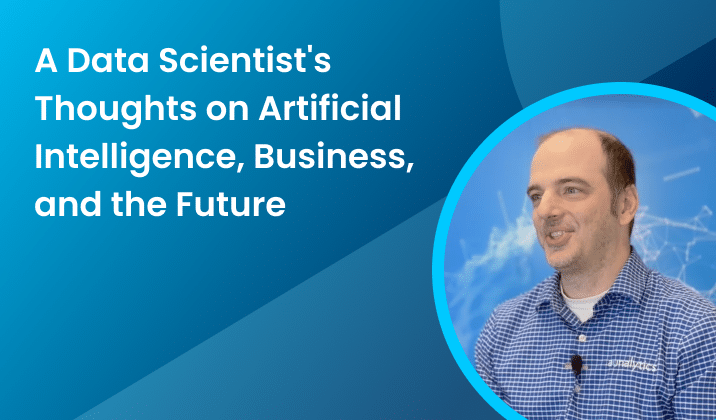
In this interview, David Cieslak, PhD, the Chief Data Scientist at Aunalytics, describes complex analytics concepts such as artificial intelligence, machine learning, and deep learning, and explains how they are useful for businesses today—and will continue to be in the future. David has been with Aunalytics since its inception and leads its Innovation Lab in the development and delivery of complex algorithms designed to solve business problems in the manufacturing/supply chain, financial, healthcare, and media sectors.
Related Content
Nothing found.

Do you have the tools and talent to set your organization up for analytics success?
Most business leaders would agree: data is a valuable asset. Having up-to-date, accurate data with which to make data-driven decisions currently gives organizations an edge, but eventually, this will become table stakes in most industries, simply to remain competitive. However, an up-front investment in a strong technical foundation and a shift to embrace analytics culture throughout the organization are required to achieve analytics success.

Unfortunately, there are many challenges to overcome when trying to bring siloed and dirty data from multiple sources across your business to a single place to be analyzed, including a lack of time and manpower, and the need for data points that don’t currently exist, to name a few. Using data analytics, it becomes possible to better optimize your business by discovering operational efficiencies, reducing costs, tracking customer trends across your organization, and making strategic decisions based on predictive data models. Is partnering with analytics experts the best choice for mid-sized institutions, or should you hire Full-Time Employees (FTEs) to build and manage your data?
There are multiple ways an analytics platform could be created—we’re going to look at two today.
Build it yourself
The first is choosing to create a custom data platform. While not a bad choice, it could take a FTE years to create your analytics platform—if it’s ever finished. An engineer hired to build a custom platform may leave you high and dry with no one to step in to help. Something like this could cost your business months—or even years—of lost money and productivity, leaving you with nothing to show for your platform building efforts.
Even if your data engineer remains with your business, there are other challenges you may encounter. It can be difficult for a single FTE to stay up to date on the newest technological advances and upgrades. Especially when that person is not only expected to clean and update information on thousands of data records, but also take care of system and software updates, keep up with changing trends in the analytics world, and more. A lack of manpower can also make tasks like finding trends in your data nearly impossible, as data processing may be far behind where your most recent and relevant business analytics can be found.
When it comes to advanced analytics, you would need to find and hire additional employees who are skilled in advanced data analytics, machine learning, and AI techniques, and ideally, familiar with your industry. This can be easier said than done. Data scientists, like many in the technology field, are in high demand, and may be difficult to find and hire in smaller geographical markets.
Work with a partner
A different option is working with a trusted technology partner who brings data analytics expertise straight to you. Partnering with an end-to-end provider often saves your company money while allowing someone else to take care of the nitty gritty that goes into creating reports, graphs, charts, and more. Additionally, you are guaranteed to have access to the team you need to build algorithms and find insights in your data. A partner will consistently provide you with the right tools, talent, and resources, while supporting you the entire way. But how could an Analytics as a Service partner help you find the true value of your data?
A good partner will be able to offer the required resources to achieve analytics success—a foundational data platform, automated data management, access to data experts, and data delivery methods such as relevant and actionable dashboards and reports. Imagine having a regular report, generated overnight, every night, for you to review first thing in the morning—without having to invest in many new FTEs and years of development time.
When looking for a data analytics partner, all the things above are important for creating a successful partnership that leads to analytics success. Aunalytics provides data processing and analytics help and would never expect you to go it alone. When you hire us, you hire data scientists, data engineers, and data analysts, reducing the need for multiple expensive FTEs. By having access to a team of data experts by your side, your business can find itself enabled to make better, faster, and smarter decisions based on consistent, real-time data.
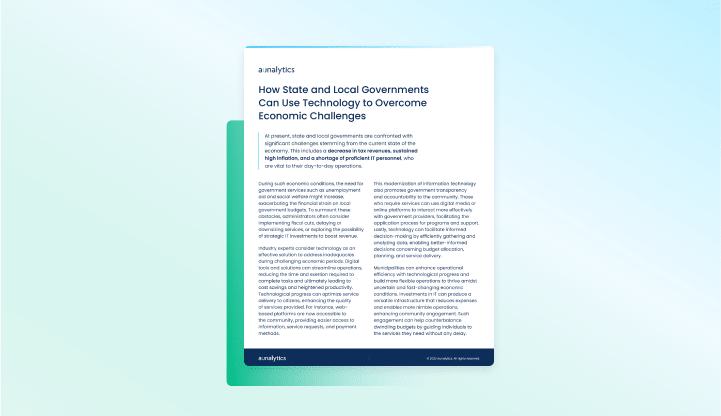
How State and Local Governments Can Use Technology to Overcome Economic Challenges
How State and Local Governments Can Use Technology to Overcome Economic Challenges
At present, state and local governments are confronted with significant challenges stemming from the current state of the economy. This includes a decrease in tax revenues, sustained high inflation, and a shortage of proficient IT personnel, who are vital to their day-to-day operations. Industry experts consider technology as an effective solution to address inadequacies during challenging economic periods.